
marble in wet areas — , , pool decks, spa rooms — can be absolutely stunning. But it's also where most marble installations go wrong.
These seven mistakes account for 90% of marble bathroom complaints. Every one of them is preventable.
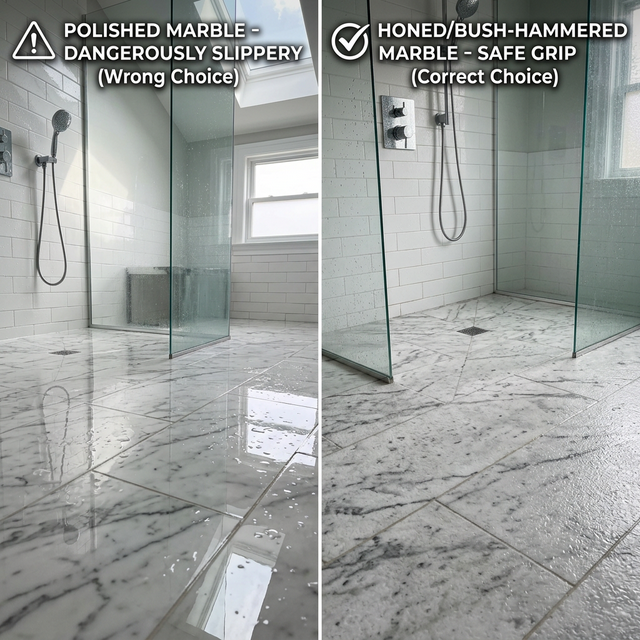
Mistake 1: Using Polished Marble on Shower Floors
What happens: Polished marble becomes dangerously slippery when wet. Even with a bath mat, the smooth surface offers almost zero grip for bare wet feet.
The fix: Use bush-hammered or sandblasted finish for all shower floors — these provide R11+ slip resistance ratings. For general bathroom floors, honed finish offers moderate grip and is the minimum acceptable standard.
| Surface | Minimum Finish | Minimum Slip Rating |
|---|---|---|
| Shower floor | Bush-hammered or sandblasted | R11 |
| Bathroom floor | Honed | R10 |
| Pool surround | Bush-hammered | R12 |
| Shower wall | Any (no slip concern) | N/A |
→ Related reading: Marble Finish Comparison Chart
Mistake 2: Skipping the Waterproof Membrane
What happens: Water seeps through marble (which is porous at 0.10–0.20% absorption) and through grout lines, reaching the wall substrate. Over months, this causes mold growth inside the wall structure, substrate deterioration, and eventually tiles falling off.
The fix: Always install a waterproof membrane (Schluter DITRA, Laticrete Hydro Ban, or equivalent) between the substrate and the marble. The membrane — NOT the marble — is what keeps water out of your wall structure.
| Component | Waterproof? |
|---|---|
| marble slab/tile | ❌ No — it's porous |
| Epoxy grout | ✅ Yes |
| Cement grout | ❌ No — also porous |
| Waterproof membrane | ✅ Yes — this is your real barrier |
Mistake 3: Using Cement-Based Grout Instead of Epoxy
What happens: Cement grout is porous — it absorbs water, grows mold (black grout lines within 6 months), and stains from soap and shampoo. In a shower, it becomes the ugliest part of an otherwise beautiful marble installation.
The fix: Use epoxy grout exclusively in all wet-area marble installations. Epoxy grout is:
- 100% waterproof
- Mold and mildew resistant
- Stain-proof
- Available in color-matched shades
Yes, epoxy grout is harder to apply and costs 3–5× more than cement grout. It's worth every cent in a marble bathroom.
Mistake 4: Not Sealing Before First Use
What happens: Fresh marble (especially honed finish) has wide-open pores. The first time soap, shampoo, or cosmetics touch an unsealed marble , the liquid absorbs immediately and stains permanently.
The fix: Apply impregnating sealer before the first use — ideally before grouting. This gives the stone maximum protection from day one.
| Sealing Timeline | Action |
|---|---|
| After installation, before grouting | First coat of impregnating sealer |
| After grouting, before first use | Second coat of sealer |
| Every 6–12 months thereafter | Maintenance resealing |
→ Related reading: Complete Marble Sealing Guide
Mistake 5: Ignoring Proper Drainage Slope
What happens: Water pools on flat marble floors instead of draining. Standing water accelerates staining, mineral deposit buildup, and mold growth in grout lines. In a curbless shower, it can flood the entire bathroom.
The fix: All wet-zone floors must slope toward the drain:
| Area | Minimum Slope | Drain Type |
|---|---|---|
| Shower floor | 1.5–2% (1.5–2 cm per meter) | Linear drain or center drain |
| Curbless shower | 1–1.5% | Linear drain at shower edge |
| General bathroom floor | 0.5–1% | Floor drain or threshold slope |
Pro tip: A linear channel drain along one wall allows a single-direction slope, which is easier to execute and looks cleaner than a 4-way slope to a center drain.
Mistake 6: Choosing a High-Porosity Marble for Wet Areas
What happens: Some marbles absorb water much faster than others. High-porosity varieties become perpetually damp, darkened, and stain-prone in a wet environment — even with sealing.
The fix: For wet areas, choose marbles with water absorption ≤ 0.15%. Avoid marbles with visible cracks, open fissures, or rusty iron inclusions.
| Variety | Absorption | Wet Area Suitability |
|---|---|---|
| Helen White | ~0.10% | ✅ Excellent |
| Jazz White | ~0.12% | ✅ Excellent |
| Elephant White | ~0.13% | ✅ Good |
| ~0.15% | ✅ Good | |
| Some beige/brown marbles | 0.25%+ | ⚠️ Not recommended |
| Unfilled travertine | 1.0%+ (with voids) | ❌ Only for dry areas |
→ Related reading: 5 Quick Tests to Check Marble Quality — Water Drop Test
Mistake 7: Using Acidic Cleaners for "Deep Cleaning"
What happens: Homeowners reach for bathroom cleaners (Lysol, Clorox, vinegar solutions) to remove soap scum or hard water buildup from marble. These products are acidic (pH 2–4) and chemically etch the marble surface, creating permanent dull spots.
The fix: Use ONLY pH-neutral cleaners labeled "safe for natural stone." For hard water deposits specifically, use a stone-safe mineral remover (not vinegar).
| Cleaning Scenario | Use This | Never Use This |
|---|---|---|
| Daily wipe | Warm water + microfiber | Generic bathroom spray |
| Weekly clean | pH-neutral stone cleaner | Vinegar solution |
| Soap scum buildup | Stone-safe bathroom cleaner | Bleach |
| Hard water deposits | Stone-safe mineral remover | CLR, Lime-Away |
| Mold on grout | Hydrogen peroxide (3%) spray | Bleach or ammonia |
→ Related reading: Complete Products Guide: What NEVER to Use on Marble
Quick Checklist: Before Your Marble Bathroom Installation
Use this as a pre-installation signoff checklist:
- [ ] Marble variety has water absorption ≤ 0.15% (verified by water test or ASTM data)
- [ ] Shower floor specified as bush-hammered or sandblasted (R11+)
- [ ] Bathroom floor specified as honed at minimum (R10+)
- [ ] Waterproof membrane specified in scope of work
- [ ] Epoxy grout specified (NOT cement grout)
- [ ] Linear or center drain specified with correct slope
- [ ] Impregnating sealer included in installation scope
- [ ] pH-neutral stone cleaner purchased for maintenance
- [ ] Maintenance schedule shared with homeowner or facilities team
Questions to Ask Your Contractor Before Installation
Before any marble wet-area installation begins, ask your contractor these 7 questions — they'll instantly reveal whether they have the experience to do the job right:
| Question | Correct Answer | Red Flag |
|---|---|---|
| What waterproof membrane will you use? | Names a specific product (Schluter DITRA, Laticrete Hydro Ban, Wedi) | "The marble itself is waterproof" or no specific product named |
| What grout type? | Epoxy grout | Cement-based grout |
| What's the shower floor slope? | 1.5–2% toward drain | "We'll make sure water drains" (no specific number) |
| Will you seal before grouting? | Yes — first coat before grout, second coat before use | "We seal after everything is done" |
| What finish on the shower floor? | Bush-hammered or sandblasted (R11+) | "Polished" or "same as the walls" |
| How will you waterproof the niche? | Membrane wraps all 5 interior surfaces + pre-formed corners | "We'll just tile it" or no mention of niche waterproofing |
| Can you show me 3 completed marble shower projects? | Yes, with photos and client references | Hesitation or "we've done lots of tile showers" |
Bottom line: A contractor who can't answer these questions specifically shouldn't be installing marble in wet areas. The cost of getting it wrong ($5,000–20,000+ in remediation) far exceeds the cost of hiring someone more experienced.
Part of the Marble Bathroom Design series. Published by FutureStone Group — direct marble manufacturer and exporter. Get expert material advice →
Marble care and wet-area maintenance hub
This guide connects common wet-area design mistakes with FutureStone's marble care and wet-area maintenance hub. It is written for architects, contractors, hotel buyers, villa owners and importers who need marble shower, bathroom, wet-room, vanity and countertop decisions to survive real water exposure, cleaning routines and project handover.
Buyer intent: wet-room marble risk checklist for shower walls, bathroom floors, vanity tops, tub surrounds, kitchen-adjacent wet zones and commercial stone projects.
Wet-room marble risk checklist
- Choose the correct finish for slip resistance, cleaning and stain visibility before approving marble for shower floors or wet-room floors.
- Confirm waterproofing, drainage slope, joint layout, edge treatment and access for replacement before fabrication starts.
- Avoid assuming sealer makes marble waterproof. Sealer helps slow absorption, but the substrate, drainage and maintenance routine still decide long-term performance.
- Ask for finish samples, slab photos, dry-lay review, spare tiles and cleaning guidance before the order ships.
For material selection and project sourcing, compare marble slabs and tiles, review wet-area proof in basin and tub projects, check sink and counter details in kitchen countertop projects, and send drawings, size, finish, quantity, water exposure and destination through FutureStone contact for project review.
Marble wet-area FAQ
Can marble be used in wet rooms and showers?
Yes, marble can be used in wet rooms and showers when the stone, finish, waterproofing, drainage, sealing plan and cleaning routine are specified together. Honed or textured surfaces may be safer for floors, while polished marble is usually better suited to walls or lower-slip-risk areas.
What is the biggest mistake when specifying marble for wet areas?
The biggest mistake is treating sealing as the only protection. Wet-area marble also needs correct substrate waterproofing, slope, joint layout, compatible cleaner, ventilation and maintenance instructions.
What should be included in a wet-area marble RFQ?
Include drawings, dimensions, stone preference, finish, water exposure, slip-resistance needs, edge profiles, quantity, spare allowance, delivery country and installation schedule so the supplier can review risk before quoting.