
"How often should I seal my marble?" is the #1 maintenance question marble owners ask. The answer depends on three factors: where the marble is installed, what finish it has, and how intensively it's used.
This quick guide gives you a definitive resealing schedule — plus the 2-minute test that tells you exactly when your marble needs attention.
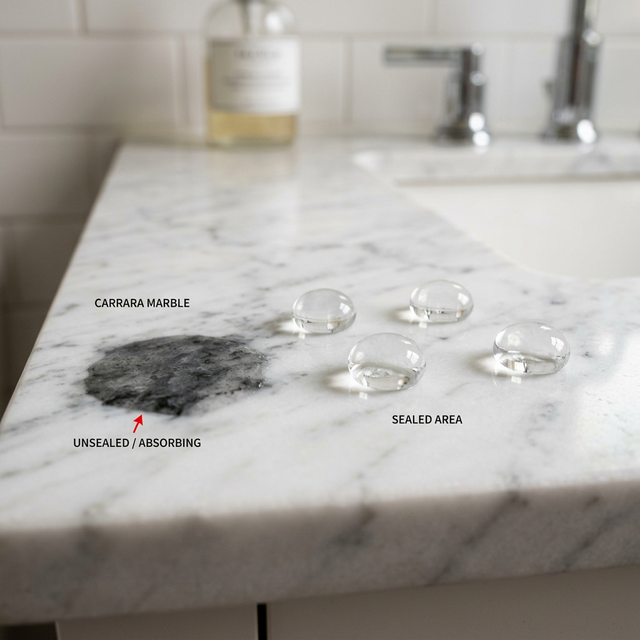

The Water Drop Test: Your 2-Minute Answer
Before following any schedule blindly, test your marble first. Every installation is different.
| Step | Action |
|---|---|
| 1 | Sprinkle 4–5 drops of water on the marble surface |
| 2 | Wait exactly 10 minutes |
| 3 | Observe the result: |
| Result | Sealer Status | Action Needed |
|---|---|---|
| Water still beads on surface, no darkening | ✅ Sealer is active and working | No resealing needed — check again in 3 months |
| Water has partially absorbed, slight darkening visible | ⚠️ Sealer is weakening | Reseal within the next 2–4 weeks |
| Water absorbed quickly, clear dark wet spot | ❌ No sealer protection | Reseal immediately |
Test location matters: Test the most heavily used spot (near the stove for kitchens, around the faucet for , center of the floor for high-traffic areas). Sealant wears unevenly — the most-used area fails first.
→ Related reading: 5 Quick Tests to Check Marble Quality
Resealing Schedule by Application
| Application | Seal Frequency | Usage Intensity | Key Threat |
|---|---|---|---|
| Kitchen countertop | Every 6 months | Very High | Food acids, oils, constant wiping |
| Kitchen island | Every 6 months | Very High | Prep work, spills, cutting |
| Dining table | Every 6–12 months | High | Food, drinks, daily wiping |
| Coffee table | Every 12 months | Medium | Drink rings, occasional spills |
| Bathroom vanity | Every 6–12 months | Medium-High | Cosmetics, toothpaste, water |
| Shower walls | Every 12 months | High | Constant water, soap, shampoo |
| Bathroom floor | Every 12 months | Medium-High | Water, foot traffic |
| Living room floor | Every 12–18 months | Medium | Foot traffic, occasional spills |
| Feature wall | Every 24 months | Very Low | Dust, minimal contact |
| Fireplace surround | Every 18–24 months | Low | Soot, heat (indirect) |
| **** | Every 12 months | High | Foot traffic, grit |
| Exterior facade / pool deck | Every 6–12 months | Variable | Rain, UV, freeze-thaw |
Resealing Schedule by Finish
Surface finish significantly affects how fast sealer wears off:
| Finish | Pore Openness | Seal Wear Rate | Adjustment |
|---|---|---|---|
| Polished | Low (pores mechanically closed) | Slowest wear | Can extend schedule by 25% |
| Honed | Medium-High (pores partially open) | Faster wear | Follow schedule strictly — honed marble needs timely sealing |
| Leathered | Medium | Moderate wear | Follow standard schedule |
| Brushed | Medium-High | Faster wear | Same as honed — test frequently |
| Bush-hammered | High (very open texture) | Fastest wear | Shorten schedule by 25% for outdoor use |
→ Related reading: Marble Finish Comparison Chart
Sealer Product Recommendations
| Product | Type | Best For | Coverage | Price |
|---|---|---|---|---|
| Tenax Proseal | Solvent-based impregnating | All indoor marble — top professional choice | 15–20 m²/L | $ |
| StoneTech BulletProof | Water-based impregnating | Kitchens, bathrooms, food-safe | 15–25 m²/L | $$ |
| Miracle 511 Porous Plus | Solvent-based impregnating | Large floor areas, cost-effective | 15–30 m²/L | $ |
| Lithofin Stain-Stop | Water-based impregnating | Eco-friendly projects, low-VOC | 10–20 m²/L | $$ |
| Akemi Darkener Anti-Stain | Color-enhancing impregnating | Dark marbles — deepens color while sealing | 10–15 m²/L | $ |
Important: Always use impregnating (penetrating) sealers — never topical/coating sealers. Topical sealers create a surface film that peels, traps moisture, and alters the marble's natural appearance.
Step-by-Step Sealing Procedure
| Step | Action | Time |
|---|---|---|
| 1 | Clean marble with pH-neutral stone cleaner | 15 min |
| 2 | Dry completely — wait 24 hours after cleaning (trapped moisture = haze) | 24 hours |
| 3 | Apply first coat with lint-free cloth or lamb's wool pad, working in 1 m² sections | 15 min |
| 4 | Let absorb for 5–15 minutes (per product label) | 5–15 min |
| 5 | Buff excess with dry clean microfiber cloth — don't let sealer dry on surface | 10 min |
| 6 | Wait 30–60 minutes | 30–60 min |
| 7 | Apply second coat (recommended for honed + all countertops), repeat steps 3–5 | 15 min |
| 8 | Cure — light use after 6 hours, full use after 24 hours, heavy exposure after 72 hours | 24–72 hours |
Annual Sealing Calendar (Typical Luxury Home)
| Month | Action |
|---|---|
| January | Water-test all surfaces — identify what needs resealing |
| February | Reseal kitchen countertops + dining table |
| March | — |
| April | Deep clean + reseal bathroom vanities and shower walls |
| May | — |
| June | Reseal outdoor marble (before summer heat/use peak) |
| July | — |
| August | Reseal kitchen countertops (second cycle) |
| September | — |
| October | Reseal bathroom vanities (second cycle) + living room floors |
| November | Deep clean all marble before holiday entertaining season |
| December | Reseal outdoor marble (before winter freeze, if applicable) |
Sealer Cost Calculator
Use this quick reference to estimate sealer costs for your project:
| Surface | Area (typical) | Sealer Needed | Product Cost | Annual Cost (2 applications) |
|---|---|---|---|---|
| Kitchen countertop | 2–4 m² | 0.2–0.3 L | $8–15 | $16–30 |
| Bathroom vanity | 0.5–1.5 m² | 0.1–0.15 L | $4–8 | $8–16 |
| Shower (walls + floor) | 5–8 m² | 0.4–0.6 L | $15–25 | $15–25 |
| Living room floor | 20–40 m² | 1.5–3 L | $40–100 | $40–100 |
| Full bathroom | 10–15 m² | 0.8–1.2 L | $25–45 | $50–90 |
| Whole house (floors) | 80–150 m² | 5–10 L | $120–350 | $120–350 |
Cost perspective: Sealing an entire luxury home (150 m² of marble) costs $120–350/year in product. A single professional marble restoration callout for a stained countertop costs $200–500. Prevention is dramatically cheaper than cure.
5 Common Sealing Mistakes
| Mistake | What Happens | How to Avoid |
|---|---|---|
| Sealing over a wet surface | Sealer traps moisture → permanent hazy white film | Wait 24 hours after cleaning; surface must be bone dry |
| Not buffing excess | Sealer dries ON the surface → sticky, streaky residue | Buff with dry microfiber within 5–15 minutes of application |
| Using topical (coating) sealer | Creates surface film that peels, yellows, and traps moisture | Use only impregnating (penetrating) sealers |
| Skipping the second coat | Single coat provides 60–70% protection; two coats reach 95%+ | Always apply two coats, especially on honed and high-use surfaces |
| Testing where nobody walks | Corner passes water test while high-traffic center area is unprotected | Test the most-used spot — near the stove, around the faucet, center of the floor |
FAQs
Can I over-seal marble?
Technically no — excess sealer simply won't absorb and gets buffed off. But applying sealer on a surface that's still wet or has existing sealer buildup can create a hazy film. Always do the water test before resealing to confirm it's actually needed.
Does sealing prevent etching from lemon juice?
No. Sealing reduces staining (absorption of color) but does NOT prevent etching (acid chemical reaction on the surface). To prevent etching, you must avoid acidic contact — or choose a honed/leathered finish that masks etch marks.
How long does sealing take for a full bathroom?
About 2 hours of active work (cleaning + two coats + buffing), spread over 2 days (to allow the 24-hour drying period between cleaning and sealing).
Part of the Marble Care & Maintenance Guide series. Published by FutureStone Group — direct marble manufacturer and exporter. Browse our low-porosity marble varieties → | Contact us →
Marble care and wet-area maintenance hub
This article is part of FutureStone's marble care and wet-area maintenance hub for architects, contractors, hotel buyers, villa owners and importers who need practical stone guidance before choosing bathroom marble, kitchen marble, vanity tops, shower walls or floor tiles. Use it to connect maintenance advice with material selection, finish approval, waterproofing coordination and project RFQ documents.
Buyer intent: sealing schedule by room and use case for marble bathrooms, showers, kitchens, vanity tops, floors and commercial stone projects.
Marble resealing schedule by application
- Bathrooms and showers: test water absorption every 6 to 12 months, because steam, soap residue and frequent cleaning can weaken the sealer faster than dry rooms.
- Kitchen countertops and islands: test every 6 to 12 months around sink cut-outs, cooking zones and high-touch edges before stains become visible.
- Floors, stairs and lobby stone: review every 12 to 24 months depending on foot traffic, finish, cleaning chemicals and mat placement.
- Vanity tops and basin surrounds: check water beading, soap marks, cosmetics and edge darkening before approving the next maintenance cycle.
For new projects, choose the stone and finish before deciding the maintenance plan. Compare marble slabs and tiles, review bathroom proof in basin and tub projects, check kitchen use in kitchen countertop projects, and send drawings, finish, quantity, destination and usage conditions through FutureStone contact for project advice.
Marble care FAQ
How often should marble be resealed in a bathroom?
Most marble bathrooms should be water-tested every 6 to 12 months. Reseal when water no longer beads on the surface, when edges darken quickly, or when the shower, vanity or tub surround is exposed to frequent cleaning chemicals.
Does every marble surface need the same resealing schedule?
No. Polished walls in dry areas often need less attention than honed shower floors, kitchen countertops, vanity tops or high-traffic floors. Finish, porosity, cleaning routine and water exposure should decide the maintenance interval.
What should project buyers confirm before ordering marble for wet areas?
Confirm the marble type, finish sample, water exposure, waterproofing details, drainage slope, sealing plan, spare material allowance and cleaning method before production or installation begins.
Need a material or project recommendation?
Share the page, material target or project requirement with our team.