
You spilled red wine on your Calacatta Viola countertop. Or discovered a mysterious brown ring on your travertine bathroom vanity. Or noticed an orange spot slowly spreading on your white marble floor.
Don't panic — and don't reach for bleach, vinegar, or a generic stain remover. Those will make things worse.
This guide gives you the exact procedure stone restoration professionals use — the poultice method — adapted for every common stain type, with products you can buy at any hardware store.
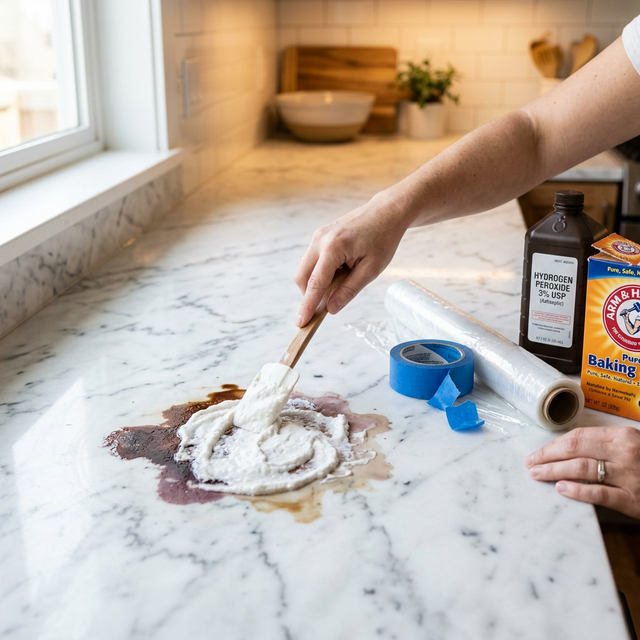
First: Identify Your Problem
Before treating, you need to know whether you're dealing with a stain or an etch mark — they look similar but require completely different fixes.
| Feature | Stain | Etch Mark |
|---|---|---|
| What happened | A colored liquid soaked INTO the stone | An acidic liquid reacted WITH the stone surface |
| Visual appearance | Dark spot or discoloration below the surface | Dull, lighter patch ON the surface |
| Touch test | Surface feels the same as surrounding area | Surface feels rougher or less glossy |
| Common causes | Wine, coffee, oil, rust, ink | Lemon juice, vinegar, tomato sauce, wine (also etches!) |
| Fix method | Poultice (draws stain out) | Re-polishing (restores surface) |
Note: Red wine can cause BOTH — a stain (from the pigment absorbing in) AND an etch mark (from the acid reacting with the surface). Treat the stain first, then address the etch.
→ For etch mark repair, see: Marble Care Guide — Etch Mark Removal
The Poultice Method: How It Works
A poultice is a thick paste that you apply over the stained area and leave to dry. As the paste dries, it draws the stain upward and out of the stone through capillary action — like a reverse sponge.
Basic Poultice Recipe
| Component | Role | Options |
|---|---|---|
| Absorbent base | Draws liquid out of stone | Baking soda, kaolin clay, diatomaceous earth, paper towels |
| Chemical agent | Dissolves or lifts the specific stain type | Varies by stain — see below |
| Plastic wrap | Keeps poultice moist long enough to work | Standard kitchen plastic wrap |
| Tape | Seals edges of plastic wrap | Painter's tape (won't damage marble) |
Universal Application Steps
| Step | Action | Detail |
|---|---|---|
| 1 | Clean the area | Remove loose debris with pH-neutral stone cleaner |
| 2 | Dampen the marble | Lightly mist with distilled water (helps capillary flow) |
| 3 | Mix poultice | Combine absorbent base + chemical agent to a thick peanut-butter consistency |
| 4 | Apply | Spread 6–8mm thick over stain, extending 2 cm beyond the stain edge |
| 5 | Cover | Place plastic wrap over poultice, tape all edges |
| 6 | Wait | 24–48 hours — the poultice MUST dry completely (this is what pulls the stain up) |
| 7 | Remove | Peel off plastic, scrape dried poultice with plastic spatula (never metal) |
| 8 | Rinse | Clean area with distilled water, dry with soft cloth |
| 9 | Assess | If stain reduced but not gone, repeat (some deep stains need 2–3 rounds) |
| 10 | Reseal | Apply impregnating sealer to treated area (poultice strips existing sealant) |
Stain-Specific Recipes
Red Wine
| Detail | Specification |
|---|---|
| Stain type | Organic (pigment) + acid etch (tartaric acid) |
| Urgency | High — blot immediately, don't rub |
| Absorbent base | Baking soda |
| Chemical agent | 12% hydrogen peroxide |
| Mix ratio | 3 parts baking soda : 1 part hydrogen peroxide |
| Dwell time | 24–48 hours |
| Expected result | 80–100% removal in 1–2 applications for sealed marble; may require 3+ for unsealed |
| After treatment | Address any remaining etch mark with marble polishing powder |
Emergency first response: If the spill just happened — pour table salt on the wet wine immediately. Salt absorbs the liquid before it penetrates. Sweep up after 5 minutes, then proceed with the poultice if staining remains.
Coffee / Tea
| Detail | Specification |
|---|---|
| Stain type | Organic (tannin pigment) |
| Urgency | Medium — wipe up promptly |
| Absorbent base | Baking soda or kaolin clay |
| Chemical agent | 12% hydrogen peroxide |
| Mix ratio | 3:1 (base : peroxide) |
| Dwell time | 24–48 hours |
| Expected result | 90–100% removal in 1 application for fresh stains; 2–3 for old set-in stains |
Prevention tip: Use coasters on marble coffee tables and dining tables. A daily latte habit without a coaster will stain even sealed marble within weeks.
Cooking Oil / Butter / Grease
| Detail | Specification |
|---|---|
| Stain type | Oil-based (darkens stone as oil absorbs into pores) |
| Urgency | Medium — blot excess, don't spread |
| Absorbent base | Baking soda |
| Chemical agent | Acetone (nail polish remover — 100% acetone, NOT the colored kind) |
| Mix ratio | Thick paste (add acetone until peanut-butter consistency) |
| Dwell time | 24 hours (acetone evaporates faster than peroxide) |
| Expected result | 85–100% removal in 1–2 applications |
Alternative method for light oil stains: Sprinkle dry cornstarch or baking soda on the stain, leave for 24 hours (no plastic wrap — let it air-absorb), sweep up. May work for surface-level oil that hasn't penetrated deeply.
Rust (Orange/Brown Spots)
| Detail | Specification |
|---|---|
| Stain type | Metallic (iron oxidation — can be from iron deposits IN the marble or from metal objects placed ON it) |
| Urgency | Low-medium — rust stains are stubborn but don't spread quickly |
| Absorbent base | Not needed for liquid rust remover; use kaolin clay for a poultice |
| Chemical agent | Commercial stone rust remover (Iron-Out, Lithofin Rust-Ex, Akemi Rust Remover) |
| Application | Apply directly per product instructions, OR mix with kaolin clay for a poultice |
| Dwell time | 15 minutes–2 hours (follow product label) |
| Expected result | 70–90% removal in 1 application; deep/old rust may require professional treatment |
⚠️ Critical: NEVER use generic hardware-store rust removers on marble. They typically contain hydrochloric or phosphoric acid that will severely etch the marble surface. Only use products specifically labeled "safe for natural stone."
Preventing internal rust: If your marble has visible iron-rich inclusions (small dark metallic dots), seal the stone more frequently and avoid prolonged water contact. The iron in the stone itself oxidizes when wet. There's no way to stop this permanently — only slow it with diligent sealing. This is common in some beige and brown marbles.
Ink / Marker
| Detail | Specification |
|---|---|
| Stain type | Dye-based organic |
| Chemical agent for LIGHT marble | 12% hydrogen peroxide + baking soda poultice |
| Chemical agent for DARK marble | Acetone + baking soda poultice (peroxide may lighten dark stone) |
| Dwell time | 24 hours |
| Expected result | 80–95% removal; permanent marker is hardest |
Hard Water / Mineral Deposits
| Detail | Specification |
|---|---|
| Stain type | Mineral buildup (calcium, lime from hard water) |
| Appearance | White crusty film or water ring marks |
| Treatment | DO NOT use vinegar or CLR (acid!). Use a pH-neutral stone-safe mineral remover |
| Recommended product | StoneTech Restore (acidic but formulated for stone), Lithofin Bath Cleaner |
| Application | Apply, wait 5 minutes, scrub gently with soft brush, rinse immediately |
| Prevention | Squeegee shower walls after every use; wipe vanity tops dry |
Cosmetics / Hair Dye
| Detail | Specification |
|---|---|
| Stain type | Organic dye + oil base |
| Treatment | Hydrogen peroxide poultice first; if stain persists, follow with acetone poultice |
| Challenge level | High — hair dye is one of the most difficult marble stains |
| Prevention | Place a protective mat before using hair dye near marble vanities |
Quick Reference: Stain Treatment Matrix
| Stain | Chemical Agent | Base | Wrap? | Time | Difficulty |
|---|---|---|---|---|---|
| Red wine | Hydrogen peroxide 12% | Baking soda | Yes | 24–48h | ⭐⭐ |
| Coffee / tea | Hydrogen peroxide 12% | Baking soda | Yes | 24–48h | ⭐⭐ |
| Cooking oil | Acetone | Baking soda | Yes | 24h | ⭐⭐ |
| Rust | Stone-safe rust remover | Kaolin clay | Yes | 1–2h | ⭐⭐⭐ |
| Ink | Peroxide (light) / Acetone (dark) | Baking soda | Yes | 24h | ⭐⭐⭐ |
| Hard water | pH-neutral mineral remover | N/A (liquid) | No | 5 min | ⭐ |
| Cosmetics | Peroxide then acetone | Baking soda | Yes | 24h × 2 | ⭐⭐⭐⭐ |
| Hair dye | Peroxide + acetone combo | Baking soda | Yes | 48h | ⭐⭐⭐⭐⭐ |
When to Call a Professional
| Scenario | Why DIY Won't Work |
|---|---|
| Stain hasn't improved after 3 poultice applications | May need industrial-strength chemicals or mechanical treatment |
| Rust from internal iron deposits keeps returning | Requires specialist stone surgeon assessment |
| Large area of etch damage after acid spill | Needs diamond re-polishing equipment |
| Antique or irreplaceable marble | Risk of making it worse — let a conservator handle it |
| Shower or bathroom with multiple stain types | Professional can assess and treat everything systematically |
Finding a professional: Search for "natural stone restoration" in your area. Look for certifications from the Natural Stone Institute (NSI) or equivalent in your country.
Emergency Stain Response Kit
Keep this kit under your kitchen or bathroom sink for immediate stain response:
| Item | Where to Buy | Cost | Treats |
|---|---|---|---|
| Baking soda (1 kg) | Supermarket | $3–5 | All poultice bases |
| 12% hydrogen peroxide (500ml) | Pharmacy / Amazon | $5–10 | Organic stains (wine, coffee, tea) |
| 100% acetone (500ml) | Hardware store | $5–10 | Oil-based stains (grease, cosmetics) |
| Stone-safe rust remover | Stone care supplier / Amazon | $15–25 | Rust and metallic stains |
| Plastic wrap (roll) | Supermarket | $3 | Covering poultice |
| Painter's tape | Hardware store | $4–6 | Sealing poultice edges |
| pH-neutral stone cleaner | Stone care supplier / Amazon | $10–20 | Pre- and post-treatment cleaning |
| Table salt (for emergency wine spills) | Supermarket | $1 | First-response absorption |
| Plastic spatula | Kitchen store | $2–3 | Removing dried poultice |
| Nitrile gloves (box) | Pharmacy | $8–12 | Chemical handling safety |
Total kit cost: Under $60 — far less than a single professional restoration callout ($200–500).
Marble Finish and Stain Susceptibility
Not all marble finishes absorb stains equally. Your choice of finish directly affects how quickly a spill becomes a permanent stain:
| Finish | Absorption Speed | Stain Risk | Why |
|---|---|---|---|
| Polished | Slowest | Lowest | Mechanical polishing closes surface pores |
| Honed | Medium-fast | Medium-High | Open pores at the surface absorb liquids faster |
| Leathered | Medium | Medium | Texture creates some barrier but pores are partially open |
| Brushed | Fast | High | Very open surface texture |
| Bush-hammered | Fastest | Highest | Roughest surface with maximum pore exposure |
Practical takeaway: If you have honed marble countertops (the most popular choice), you need to wipe spills faster and seal more frequently than with polished marble. Consider keeping a small microfiber cloth near your coffee table and dining table for instant spill response.
FAQs
Will hydrogen peroxide damage my marble?
No — 12% hydrogen peroxide is safe for marble. It's a mild oxidizer that breaks down organic stains. Do NOT use 30%+ concentration (salon-grade) — that's too strong. And never use it on dark marble (risk of lightening the stone). Use acetone instead for dark varieties like Black Marquina.
Can I prevent stains entirely by sealing?
Sealing greatly reduces stain risk but doesn't make marble stain-proof. It buys you time — spills that would stain unsealed marble in seconds take minutes or hours on sealed marble, giving you time to clean up. See our sealing guide →
Does the marble finish affect stain resistance?
Yes. Polished marble has mechanically closed pores and is the most stain-resistant. Honed marble has more open pores and absorbs liquids faster. Leathered and brushed finishes fall in between. All finishes benefit from impregnating sealer.
Part of the Marble Care & Maintenance Guide series. Published by FutureStone Group — direct marble manufacturer and exporter. Request stain-resistant marble samples →
Marble stain removal and long-term care hub
This guide is part of FutureStone's marble stain removal and long-term care hub for homeowners, hotel maintenance teams, contractors, designers and stone importers. Use it to connect emergency stain treatment with correct material choice, finish selection, sealing schedule, wet-area risk review and project maintenance handoff.
Buyer intent: stain removal action matrix for wine, coffee, oil, rust, ink, hard-water marks and other common marble stain scenarios.
Stain removal action matrix
- Wine, coffee and tea: blot first, avoid acids, clean with a pH-neutral stone cleaner, then use a poultice method if color remains in the pores.
- Cooking oil and grease: use an absorbent poultice and repeat gently instead of scrubbing the finish or using harsh degreasers.
- Rust and metal marks: identify the source before treatment because rust removers can etch marble if they are not made for calcium-based stone.
- Hard water and soap marks: confirm whether the issue is residue, etching or deep staining before choosing a cleaner or restoration method.
For prevention and project planning, use the marble resealing schedule, the wet-area marble mistakes guide, the marble material category, basin and tub project context, and kitchen countertop project context. For a live hotel, villa or apartment project, contact FutureStone with stone type, finish, stain location, photos, drawings and maintenance requirements.
Marble stain removal FAQ
Can I use vinegar or bleach on marble stains?
No. Vinegar, bleach and many general stain removers can etch or discolor marble. Use pH-neutral stone cleaner first, then a marble-safe poultice if the stain remains.
When should I use the poultice method?
Use the poultice method when a stain has moved below the surface and normal pH-neutral cleaning does not remove it. Match the poultice material to the stain type and test a hidden area first.
When should I call a stone professional?
Call a stone professional when the mark is etching, rust, deep oil staining, widespread discoloration, or a high-value slab, countertop, floor or vanity where aggressive DIY treatment could make the damage worse.
Marble stain quick-treatment guide
Use this short route when you need a practical marble stain remover decision before reading the full treatment details. First identify the mark, blot or lift the source, use only a product confirmed safe for the selected stone, and test a hidden area before repeating any treatment. A red wine stain on marble, an oil mark and a dull spot can look similar in a photo but require different next steps.
Marble stain treatment decision table
| Problem | First response | Avoid | Escalate when |
|---|---|---|---|
| Red wine, coffee or tea stain | Blot immediately, lift residue with a pH-neutral stone cleaner and allow the surface to dry before judging the remaining color. | Vinegar, lemon, abrasive pads and untested bleach products. | The color remains below the surface, spreads across a large area or affects a valuable countertop or slab. |
| Oil or grease stain | Remove the source, absorb surface oil and consider a marble poultice matched to the stain and stone condition. | Hard scrubbing, aggressive degreasers and sealing over an active stain. | The mark returns after drying, reaches a seam or remains after a cautious poultice test. |
| Rust or orange-brown metal mark | Find the metal source and confirm whether the surface is natural marble, cultured marble or another engineered material before selecting a treatment. | Generic rust remover or acid cleaner without a calcium-based-stone safety confirmation. | The mark is deep, near a seam, caused by embedded metal or located on a high-value finished surface. |
| Dull spot, light ring or rough patch | Treat it as a possible etch first: stop acidic cleaners, inspect the finish under side light and compare the area with an untouched sample. | More stain remover, polishing powder or DIY sanding before confirming the cause. | The finish is visibly changed, the spot is widespread or the project requires a matched repair sheen. |
| Hard-water residue or soap film | Separate removable residue from etching or absorbed staining, then use a stone-safe neutral cleaner and dry the area completely. | Vinegar, acidic limescale products and metal scrapers. | The mark remains after residue is removed or appears together with a loss of gloss. |
Stain vs etch: identify the symptom first
- Stain: absorbed color or oil usually looks darker than the surrounding marble and may improve as the stone dries or after a suitable poultice.
- Etch: acid or harsh-cleaner damage usually looks dull, pale, cloudy or rough because the surface finish has been changed rather than simply discolored.
- Dull spots: do not automatically require a marble stain remover. Photograph the area in side light, check the finish and compare it with the original sample before choosing restoration.
- Cultured marble stain removal: verify the resin or gel-coat care instructions first because a method suitable for natural marble may damage an engineered or coated surface.
Stone-safe product and escalation checklist
- Read the product label and confirm compatibility with calcium-based natural stone, the selected finish and any coating or sealer.
- Test a small hidden area, use the shortest reasonable contact time and stop if color, gloss or texture changes.
- Do not mix cleaners. Keep acidic products, abrasive powders and unverified rust chemicals away from marble until the surface type is confirmed.
- Record the stone name, finish, stain source, age of the mark, cleaning products already used and before-and-after photos for a professional review.
For prevention, compare the marble resealing schedule, the wet-area marble mistakes guide and the marble finish comparison. For a replacement slab, countertop, vanity or hotel project, review the marble collection and send the stone type, finish, dimensions, photos and maintenance brief through FutureStone contact.
Quick stain-removal handoff for projects
A contractor or property team should receive the approved stone reference, finish sample, pH-neutral cleaner guidance, sealing record, stain response steps, prohibited products, spare-piece information and the supplier contact path. This handoff makes stain removal repeatable across kitchens, bathrooms, hotel rooms, lobby floors and stone furniture instead of relying on an unverified product recommendation.
Need a material or project recommendation?
Share the page, material target or project requirement with our team.