
A flawless slab of Calacatta Viola worth $5,000 becomes worthless if it arrives cracked. And unfortunately, transit damage is the #1 cause of marble import disputes.
The difference between a successful delivery and a costly insurance claim almost always comes down to how the stone was packed before it left the factory.
This guide covers the packing standards you should demand from any marble supplier — and what to look for when inspecting packing before shipment.
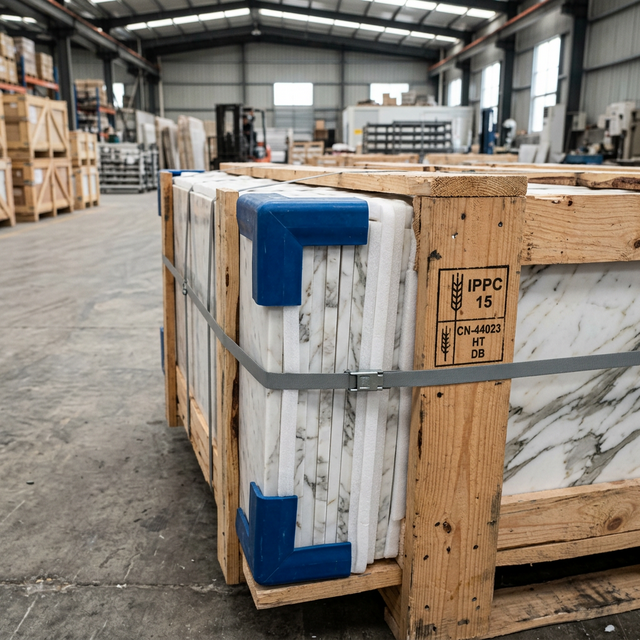
Packing Methods by Product Type
Slabs
marble slabs are packed in bundles, then placed in wooden crates or directly on A-frames inside the container.
| Packing Layer | Material | Purpose |
|---|---|---|
| Between slabs | EPE foam sheets (2–3mm) or polystyrene pads | Prevent face-to-face contact and surface scratching |
| Slab edges | Foam corner protectors + L-shaped cardboard | Prevent edge chipping during handling |
| Bundle strapping | PET or steel strapping bands (minimum 2 per bundle) | Hold slabs tightly together to prevent shifting |
| Bundle wrapping | Stretch-wrap plastic film | Moisture barrier for ocean transit |
| Crate/frame | Wooden crate or steel A-frame | Structural support and forklift handling |
Standard bundle configuration:
- 8–15 slabs per bundle (depending on thickness)
- Maximum bundle weight: 2,500–3,000 kg
- Slabs stood upright (on edge), never laid flat — laying flat causes sagging and breakage
Cut-to-Size Tiles
Tiles are packed in carton boxes inside wooden crates.
| Layer | Standard |
|---|---|
| Individual tile separation | Foam sheet or paper between each tile |
| Box fill | Tiles stood on edge, foam-packed to prevent movement |
| Box size | Typically 60×40×30 cm, max 25–30 kg per box |
| Box material | 5-layer corrugated cardboard (export quality) |
| Outer crate | Wooden crate or pallet with shrink wrap |
Labeling per box:
- Stone name and finish
- Quantity (pieces and m²)
- Box weight
- "FRAGILE — HANDLE WITH CARE" + "THIS SIDE UP" arrows
marble furniture & Custom Pieces
Marble tables, bathtubs, fireplaces, and vanities require individual custom crating.
| Packing Element | Standard |
|---|---|
| Inner wrapping | Multi-layer EPE foam (5–10mm total) covering all surfaces |
| Edge protection | High-density foam blocks on all corners and protrusions |
| Inner bracing | Foam-in-place or carved polystyrene cradle to immobilize the piece |
| Outer crate | Reinforced plywood crate, screwed (not nailed), with internal cleats |
| Crate marking | "MARBLE — FRAGILE" + weight + dimensions + handling arrows |
FutureStone Standard: All marble furniture and custom pieces are individually crated with foam-in-place cushioning. Each crate goes through a drop-simulation test before design approval.
ISPM 15: The Wooden Crate Rule You Cannot Ignore
Every wooden packing material (crates, pallets, dunnage) used in international shipping must comply with ISPM 15 — the International Standard for Phytosanitary Measures.
| Requirement | What It Means |
|---|---|
| Heat treatment (HT) | Wood heated to 56°C core temperature for 30+ minutes to kill pests |
| Methyl bromide (MB) | Alternative fumigation method (banned in many countries — use HT instead) |
| ISPM 15 stamp | Official mark must be visible on crate exterior (includes country code, producer number, treatment method) |
What happens if your crates aren't ISPM 15 compliant: