
Installing a marble bathtub is fundamentally different from installing an acrylic or cast-iron tub. The weight alone — typically 230–550 kg for the tub body, rising to 600–1,200 kg when filled with water and occupied — places structural demands on the building that must be assessed before the product is even ordered. Failing to address these requirements in advance is the most common cause of costly project delays, structural damage, and installation failures.
This guide covers every technical dimension of marble bathtub installation: structural floor assessment, plumbing rough-in, safe rigging and placement, drain connection, waterproofing, and post-installation checks. It is written for contractors, interior designers, and project managers who need a complete technical reference — not a simplified consumer overview.
Phase 1: Pre-Installation Structural Assessment
No marble bathtub installation should begin without a structural assessment. This is not a precaution — it is a prerequisite.
Understanding the Load
A natural marble bathtub imposes a concentrated point load rather than the distributed load that standard residential floor design calculations assume. When specifying floor load capacity, the relevant figure is not just the tub's dry weight but the total filled-and-occupied load concentrated over the tub's footprint area.
| Tub Size | Dry Weight (Tub Only) | Water Weight (Full) | Occupant (est.) | Total Load | Footprint Area | Load per m² |
|---|---|---|---|---|---|---|
| Standard Oval 160×75 cm | 230–300 kg | 260–300 kg | 80 kg | ~620–680 kg | ~0.9 m² | ~690–755 kg/m² |
| Large Oval 180×85 cm | 300–420 kg | 330–380 kg | 80 kg | ~710–880 kg | ~1.15 m² | ~620–765 kg/m² |
| Deep Vessel / Soaking | 320–480 kg | 380–450 kg | 80 kg | ~780–1,010 kg | ~1.0 m² | ~780–1,010 kg/m² |
| Sculptural / Boat-Shape | 350–550 kg | 330–400 kg | 80 kg | ~760–1,030 kg | ~1.05 m² | ~724–980 kg/m² |
Standard residential timber-joist floors in most markets are designed to a live load of approximately 195–245 kg/m² (40–50 psf) — substantially below the requirements above. Concrete slab construction common in hotel and apartment buildings typically supports 400–600 kg/m² as a baseline, which may still require local reinforcement directly beneath the tub footprint.
Floor Assessment Checklist
Before ordering the tub, the following must be confirmed by a licensed structural engineer:
- Floor construction type identified (timber joist, concrete slab, steel deck, or composite)
- Existing load capacity confirmed in kg/m² for the specific installation zone
- Required load capacity calculated from tub specification (see table above)
- Reinforcement scope determined if existing capacity is insufficient
- Written structural sign-off obtained before proceeding
Reinforcement Options by Floor Type
Timber joist floors: The most common scenario requiring reinforcement. Options include:
- Adding sister joists alongside existing joists beneath the tub footprint
- Installing a doubled or tripled joist beam under the tub center
- Laying a 19–25mm plywood spreader plate across multiple joists to distribute load
- In severe cases, installing a steel beam or post support from below
Concrete slab floors (hotel/apartment construction): Often adequate for ground-floor and lower-floor installations. For upper floors, request the structural engineer confirm the slab specification against the total load. Local thickening or additional reinforcement may be required if the slab was designed to minimum residential code.
Ground floor / slab-on-grade: Generally the most straightforward installation scenario. Confirm slab thickness (minimum 100mm recommended), that the ground below is compacted and stable, and that no service voids or drainage channels run directly below the installation footprint.
Phase 2: Room Access and Pre-Positioning
Moving a marble bathtub into position requires advance planning. At 230–550 kg dry weight, these are not products that can be carried by two people through a standard door opening.
Access Route Assessment
- Door clearance: The tub's external dimensions plus packaging require a clear doorway width of minimum 90 cm; 100 cm+ is preferred. For tubs exceeding 80 cm in external width, a 90-degree turn through a standard door may be impossible without tilting or removing door frames.
- Corridor width: Measure corridor length and any turns from the building entry point to the installation room. A 180 cm tub requires a straight run of at least 200 cm to maneuver through 90-degree turns.
- Stairwell limitations: Multi-story installations via stairwell are generally not feasible for tubs over 300 kg. Options: window crane, construction-phase installation before glazing is complete, or hydraulic lift equipment.
- Lift (elevator) capacity: Service lifts in hotels or apartment buildings may have a rated capacity of 500–1,000 kg. Confirm both weight and internal dimension limits before assuming lift access is viable.
Rigging Equipment
For any tub over 200 kg dry weight, mechanical lifting assistance is required:
- Furniture dollies (heavy-duty): Suitable for moving on flat, hard surfaces; rated to 400–700 kg capacity. Use two dollies in tandem for large tubs.
- Sack trucks / stair climbers: Only for moving within the same floor level on flat surfaces; not for stairs.
- Engine hoist or gantry crane: For lifting into position in rooms with ceiling height > 3m.
- Window crane or construction crane: For upper floor installation when lift access is not viable.
- Minimum crew for placement: Four people for tubs up to 350 kg; six people for tubs over 350 kg. Never attempt solo or two-person placement.
Phase 3: Plumbing Rough-In
Plumbing rough-in must be completed before the tub is placed in its final position. Retrofitting plumbing under a placed marble bathtub is extremely difficult and may require tub removal.
Drain Location
- Position the tub in its intended location (prior to final placement) and mark the drain hole location on the subfloor with a pencil.
- Remove the tub. The drain pipe should be extended to approximately 150 mm (6 inches) above finished floor level to allow connection after tub placement.
- Confirm the drain pipe diameter matches the tub's drain specification (standard: 40 mm / 1.5 inch).
Drain Types for Freestanding Stone Tubs
| Drain Type | Description | Best Application |
|---|---|---|
| Floor-mounted freestanding waste | Drain pipe runs through floor; waste trap below floor level | Concrete slab; most common for hotel installations |
| P-trap (wall connection) | Waste exits through wall at low level; trap built into wall chase | Timber floor; when sub-floor access is available |
| Island drain with flexible connector | Drain pipe with flexible section allowing minor tub repositioning | Residential installations where exact positioning may adjust |
Faucet / Tap Configuration
Freestanding marble bathtubs are incompatible with deck-mounted taps (there is no deck). Specify one of the following:
- Freestanding floor-mounted tub filler: The most common specification; the tap pillar mounts to the floor independently, with water supply pipes running below the floor. Rough-in position should be confirmed against the tub position before floor is finished.
- Wall-mounted bath filler: Supply pipes in the wall, tap spout extends over the tub rim. Requires precise wall positioning relative to the tub.
- Overhead ceiling-mounted filler (rain spout): Premium specification for spa installations; requires ceiling-level pipework run.
All supply pipe rough-in should be completed and pressure-tested before the floor finish is applied.
Phase 4: Floor Finishing and Waterproofing
The floor under and around a marble bathtub must be properly waterproofed before the tub is placed. Water infiltration beneath a stone tub — from splashing, condensation, or minor drain leakage — can cause subfloor damage, mold, and structural degradation over time.
Waterproofing Protocol
- Apply screed (if required): If pipe chases have been cut, fill and level with appropriate screed before waterproofing. Allow full cure time (typically 24–48 hours minimum).
- Clean the surface: Remove all dust, grease, and construction residue. Contaminants prevent waterproof membrane adhesion.
- Apply waterproof membrane: Use a liquid-applied or sheet-applied membrane across the entire floor area, extending 150–200 mm up all walls. Pay particular attention to floor-wall junctions and pipe penetrations.
- Seal pipe penetrations: All drain and supply pipe penetrations through the floor must be individually sealed with waterproof collars or flexible sealant before the membrane is applied over them.
- Cure the membrane: Follow the manufacturer's cure time before applying floor finish or placing the tub (typically 24–72 hours for liquid membranes).
- Apply floor finish: Tile, stone, or other floor finish applied over cured membrane.
Silicone Sealing at Tub Base
Once the tub is in its final position, apply a bead of non-water-based silicone sealant around the entire perimeter of the tub base where it contacts the floor. This prevents water from pooling under the tub body. Use a color-matched silicone; avoid white silicone against dark stone or dark flooring. Allow full cure (24 hours) before first use.
Phase 5: Tub Placement and Drain Connection
With structural preparation complete, plumbing rough-in tested, and floor finished and waterproofed, the tub is ready for final placement.
Step-by-Step Placement Procedure
- Protect the floor finish: Lay heavy cardboard or protective sheeting across the floor from the entry point to the installation position. This prevents the tub base from scratching or cracking the finished floor during sliding.
- Position the tub approximately: Using dollies, move the tub to within 30–50 cm of its final position.
- Prop the tub for drain access: Place two lengths of timber (100×100 mm) under the tub at each end, raising it 150–200 mm above the floor. This provides access to connect the drain from below.
- Connect the drain assembly:
- Thread the drain body through the drain hole from above
- Apply plumber's tape (PTFE tape) to threaded drain connections
- Apply silicone sealant under the drain flange before tightening
- Connect the drain pipe to the waste trap below, ensuring the connection is secure and aligned
- Test for leaks: Fill the tub halfway, then release the drain. From below, inspect all drain connections for leakage. Do not proceed until confirmed watertight.
- Lower the tub into final position: With the required crew, carefully remove the timber props and lower the tub onto the finished floor surface.
- Check level: Use a spirit level across the tub rim in two directions (length and width). A marble tub must be level to prevent water pooling against one end and to ensure even distribution of its weight. Use stone shims or adjustable feet (if specified) to correct any deviation.
- Apply base silicone seal: Apply a continuous bead of non-water-based silicone around the entire tub base perimeter. Tool smooth and allow 24 hours to cure.
- Connect faucet/filler: Follow the faucet manufacturer's instructions for final connection. Pressure test all supply connections before use.
Phase 6: Post-Installation Checks
Before handover to the client, complete the following post-installation verification:
Structural
- Tub sits level in both axes (spirit level confirmed, < 2 mm deviation over 1 m)
- No visible rocking or movement when pressure applied at tub rim
- Silicone seal is continuous and fully adhered at base perimeter
Plumbing
- Drain functions correctly at full fill (no slow drainage or backflow)
- All supply pipe connections are watertight at operating pressure
- Overflow (if present) drains correctly before water reaches rim
- Floor drain (if present in bathroom) is accessible and unobstructed
Surface Condition
- Tub surface inspected for installation damage (chips, scratches from transit or placement)
- Any protective film removed from the stone surface
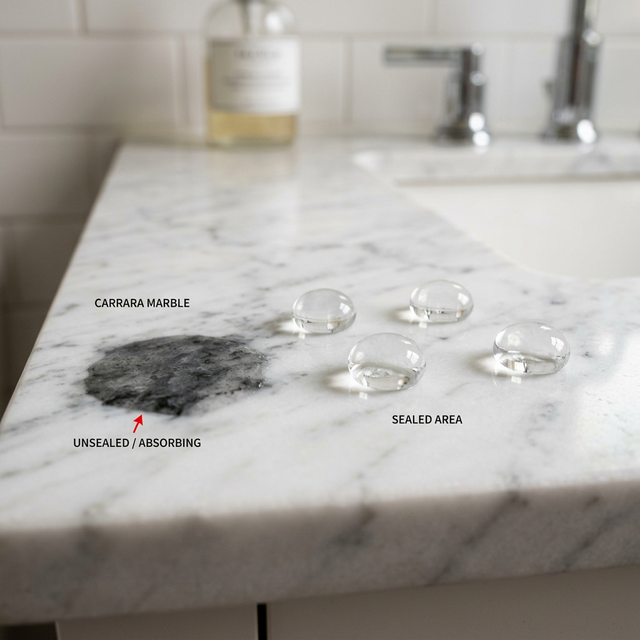
- Factory sealer is intact (surface should bead water; if water absorbs immediately, resealing is needed)
Documentation for Handover
- Stone type, grade, and finish documented for future maintenance reference
- Sealing schedule communicated to end user (marble: reseal every 12–18 months)
- Recommended cleaning products specified (pH-neutral stone cleaner only; no acid-based products)
- Structural engineer sign-off (if reinforcement was required) filed with building documentation
Common Installation Mistakes to Avoid
| Mistake | Consequence | Prevention |
|---|---|---|
| Skipping structural assessment | Floor damage, tub collapse, voided building warranty | Always obtain structural engineer sign-off before ordering |
| Finishing floor before drain position confirmed | Drain pipe in wrong position; floor must be broken up | Mark and confirm drain location with tub in position before floor finish |
| Using water-based silicone at tub base | Sealant failure within 12 months under wet conditions | Specify non-water-based silicone (acetoxy cure or neutral cure) |
| Insufficient installation crew | Tub dropped, stone cracked, personnel injury | Minimum four people for any tub over 200 kg |
| Placing tub on unprotected finished floor | Scratch or crack damage to floor or tub base | Always use protective sheeting during movement and placement |
| Using acid-based cleaners post-installation | Etching and permanent surface dullness | Communicate pH-neutral cleaner requirement at handover |
| Neglecting to level tub during placement | Uneven weight distribution, stress fractures over time | Check level with spirit level and shim before silicone is applied |
Preheating Protocol: First Use
First-time users of a marble bathtub should be advised that natural stone requires a preheating protocol before bathing:
1. Fill the tub with hot water and allow it to stand for 5–10 minutes before entering.
2. This allows the stone body to absorb heat and equilibrate to water temperature.
- Once the stone is warm, bath water temperature remains stable significantly longer than in acrylic or composite alternatives — typically maintaining comfortable temperature for 40–60 minutes.
- Do not use boiling water or direct high-pressure hot water against the stone surface repeatedly; gradual thermal equilibration is preferable.
About FutureStone Group
FutureStone Group manufactures and exports natural stone bathtubs with over 17 years of B2B production experience. All products are factory-sealed and quality-inspected before shipment. Technical drawings, dimensional specifications, and installation support documentation are available for all bathtub models.
Marble bathtub project sourcing hub
Installation planning must begin before the stone tub is carved. Confirm finished weight, structural support, drain position, waterproofing layer, access route, lifting plan and final plumbing clearance so the marble bathtub can be installed without rework.
Buyer intent: structural load, waterproofing, and plumbing coordination for project teams that need technical checks before ordering a heavy stone bathtub.
- Review basin and tub project context for application planning.
- Compare marble materials and travertine options because weight and porosity affect installation.
- Send drawings and site constraints through FutureStone contact before confirming production.
Related buying guides: stone bathtub comparison matrix, factory price vs retail price, custom sizes, drawings, crate packing, and MOQ, and Carrara, Calacatta, and Statuario bathtub selection.