
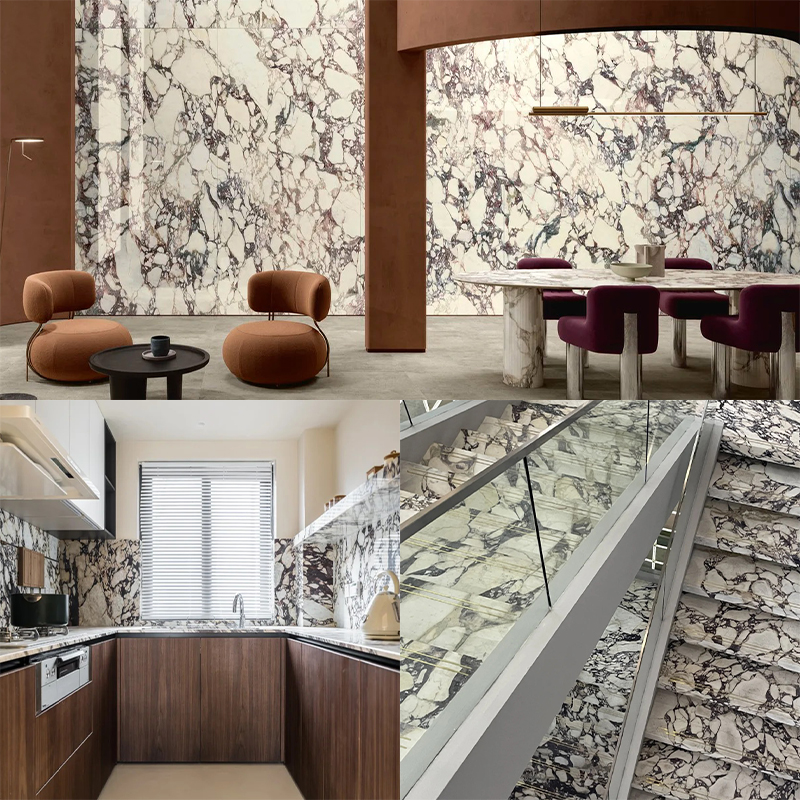
Procuring and specifying natural stone for large-scale commercial culinary spaces or high-end residential developments is fraught with hidden engineering liabilities. For architectural specifiers and general contractors, the transition from a horizontal countertop to a full-height vertical wall envelope is not merely an aesthetic choice—it is a rigorous structural challenge. Specifying a full-slab natural marble backsplash without accurate material data routinely leads to catastrophic failures: thermal shock micro-fractures behind commercial gas ranges, irreversible oleophilic staining from vaporized fats, uncontrollable color variation across different quarried blocks, or devastating shear wall-board collapse due to miscalculated dead loads.
As a vertically integrated natural stone fabricator, Future Stone Group bridges the crucial gap between interior design vision and structural mechanics. By eliminating secondary wholesale market unpredictability, we execute exact CAD specifications at the factory level. This 2026 technical hub outlines the physics, chemical resistance protocols, load mathematics, and export logistics required to successfully deploy large format engineered stone cladding and natural rock backsplashes globally.
Overcoming Structural Wall-Loading & Shear Stress
Unlike horizontal surfaces where gravitational force stabilizes the slab, a full-height vertical backsplash is entirely composed of suspended dead weight. Adhering massive panels of metamorphic rock or to a vertical envelope necessitates exacting load calculations and dedicated structural substrates.
A standard 20mm thick slab of high-density Carrara or Calacatta marble possesses a volumetric density of approximately 2,700 kg/m³. This translates to an applied dead load of roughly 55 kg/m² (~11 lbs/sq ft). Direct installation over standard 1/2-inch gypsum drywall guarantees shear failure, as the gypsum's paper facing will inevitably delaminate and tear under the continuous downward pull.
2026 architectural best practices mandate a strict structural reinforcement envelope. This typically involves deploying a 1/2-inch cementitious backer board anchored directly to structural 20-gauge metal stud framing. When correctly anchored over 16-inch on-center studs, this specific substrate configuration achieves a maximum hanging capacity exceeding 200 kg/m² (41 lbs/sq ft), securely locking the 20mm marble panel in place.
For weight-critical applications—such as elevator cab interiors, retrofits over existing structural walls, or backlit translucent Onyx panels—Future Stone Group deploys 5-axis CNC planing to mechanically reduce the natural stone thickness. Shaving the slab down to 10mm or 12mm drops the suspended wall load to a highly manageable 25 kg/m² to 30 kg/m². However, specifiers must note strict CNC edge profiling limitations on 10mm material; complex Ogee or deep Bullnose profiles are structurally impossible without inducing flexural failure, restricting ultra-thin formats to clean, eased edge or mitered waterfall profiles.
Thermal Shock Resistance and High-BTU Physics
Modern professional gas ranges (e.g., Wolf, Thermador) output intense, localized radiant heat profiles. The International Residential Code (IRC) and individual appliance manufacturers maintain zero-tolerance clearance protocols. The material specified directly behind the open flame must act as a thermally stable, non-combustible firewall.
Specifying engineered quartz—manufactured via vacuum vibro-compression technology—directly behind a high-BTU gas range is a severe specification error. While vacuum vibro-compression yields an extraordinarily dense slab with a flexural strength exceeding 45 MPa, the 7% to 10% polymer resin matrix required to bind the quartz aggregates possesses a fatal flaw. At sustained temperatures exceeding 150°C (300°F), the resin binder scorches, yellows, and permanently warps. Consequently, the IRC (Section G2409.1) mandates a strict vertical air gap clearance (often up to 30 inches above the cooktop) or the installation of specific flame-retardant millboard clad in heavy-gauge sheet metal to protect combustible or resin-bonded surfaces. Furthermore, factory QA protocols involving strict resin pooling detection are mandatory to ensure uniform heat distribution in adjacent non-cooking zones.
Conversely, natural and high-density, highly crystalline are forged under extreme geothermal heat and pressure. Their low thermal expansion coefficient (measuring approximately 8.0 to 10.0 × 10⁻⁶ /°C) grants them immense thermal inertia. Natural stone comfortably resists continuous exposure to 1000°C+ without matrix degradation, melting, or emitting toxic VOCs. When correctly mounted to a verified non-combustible wall assembly featuring steel studs, natural stone operates as an ideal firewall, frequently satisfying the coveted zero-clearance spacing requirements directly from the appliance manufacturer.
Fluoropolymer Impregnation Sealing Chemistry
A commercial or luxury residential backsplash occupies the primary continuous "splash zone." Vaporized culinary fats mix aggressively with highly acidic ingredients such as lemon juice (pH 2), vinegar (pH 3), and tomato sauce (pH 4). Because natural marble is composed primarily of basic calcium carbonate (CaCO₃), it is inherently reactive to low-pH liquids, causing an instant, dull chemical etch where the acid dissolves the topmost calcium matrix.
Cheap, topical acrylic gloss sealers are entirely useless in a high-temperature kitchen environment; they melt under ambient cooktop heat and turn yellow upon continuous UV exposure. Executing a true luxury installation mandates the application of sub-surface impregnating sealers engineered utilizing fluoropolymer nanotechnology. These specialized, solvent-based formulas penetrate deep into the stone's capillary structure, dramatically dragging the natural water absorption rate from ~0.2% down to an impregnable <0.01%. This chemical intervention creates a durable oleophobic (oil-repelling) and hydrophobic barrier without suffocating the stone's native vapor permeability (breathability), defending against aggressive culinary stains and preventing sub-surface moisture entrapment.
The Mandate for 100% Architectural Silicone Joints
One of the most frequent post-installation failures triggering devastating warranty callbacks in multi-million dollar residential custom stone projects occurs at the 90-degree internal intersection where the heavy vertical marble backsplash meets the horizontal countertops.
Custom base cabinets and underlying framing timber invariably deflect, settle, and shift slightly under the immense, concentrated dead load of heavy stone furniture and 30mm thick stone counters. Consequently, the vertical wall envelope and the horizontal base will expand and contract at fundamentally different cyclic rates.
If this transitional 90-degree joint is filled with rigid cementitious or fast-setting epoxy grout, the structural differential movement will instantly shear and fracture the grout line. This microscopic fracturing leads to persistent moisture ingress, bacterial colonization, and unhygienic mold growth cascading behind the cabinetry blind spots.
This inside right angle must be caulked exclusively with 100% architectural-grade silicone, precisely color-matched to the marble's primary background matrix. Silicone provides the critical ±25% joint movement accommodation necessary to absorb structural settlement. A critical operational nuance: to prevent liquid silicone plasticizers from migrating into the porous edges of the marble (which causes a permanent, dark "wet" stain band flanking the joint), veteran installers employ high-quality masonry tape and apply a compatible stone primer to the joint edges prior to injecting the caulking.
(Future Stone Group rigorously applies this identical expansion and silicone buffering strategy when fabricating massive integral sinks for our vanities and cabinets lines, neutralizing harmonic stress fractures during violent ocean transit and intensive daily use.)
Book-Matched Templating and 20ft Container Payload Logistics
Seamless visual integration separates premium architectural execution from standard commercial jobs. When specifying floor-to-ceiling cladding, acquiring sintered stone or large-format porcelain provides manufactured consistency. However, utilizing natural stone requires the exhaustive pursuit of flawless book-matched batch consistency. "Book-matching" demands slicing consecutive slabs directly from the singular quarried block, mirroring the opposing polished faces to generate a perfectly symmetrical, butterfly-wing aesthetic across massive wall spans. This necessitates high-resolution CNC CAD templating mapping the native geological vein flow before the diamond wet-saw initiates the primary cut.
Moving massive, fragile slabs from the fabrication floor to global job sites mandates rigorous logistics engineering. Navigating the global shipping 20ft container payload logistics requires precise volumetric weight calculations. A standard 20-foot dry marine container possesses a maximum payload capacity of roughly 28,000 kg, though highway weight restrictions at the destination port often cap the legal payload closer to 21,000 kg to 24,000 kg.
Factoring in a 20mm marble slab weight of 55 kg/m², a single 20ft container can legally transport approximately 380 to 420 square meters of finished backsplash material. Future Stone Group exports all large-format slabs using heavy-duty, heavily reinforced ISPM-15 compliant wooden A-frame bundles. This specialized bracing prevents lateral vibration and flexural sheer failure during trans-oceanic shipping, ensuring zero-defect arrival.
Secure Your Global Factory-Direct Supply Chain
Relying on fragmented secondary wholesale markets for precise architectural stone threatens project timelines with critical material shortages, unpredictable color variation, and exorbitant middleman markups. By owning the continuous supply chain from block extraction to 5-axis CNC fabrication, Future Stone Group guarantees the uncompromising structural and aesthetic integrity of your massive commercial layouts.
To acquire exact volumetric weight calculations, verified Flexural MPa testing data, or factory-direct bulk container pricing for your impending luxury residential or commercial development, contact our engineering and specification team today.


