
When you request a quote from a marble supplier, you'll often see material described as "A-Grade," "B-Grade," or "Commercial Grade." But unlike timber or steel, there is no single universal grading standard for natural marble. Grading systems vary between countries, quarries, and even individual suppliers.
This leads to confusion, mismatched expectations, and — in worst cases — buyers paying A-Grade prices for B-Grade material.
This guide explains what each grade typically means in the global stone industry, how to evaluate quality yourself, and what to specify in your purchase order to avoid disputes.

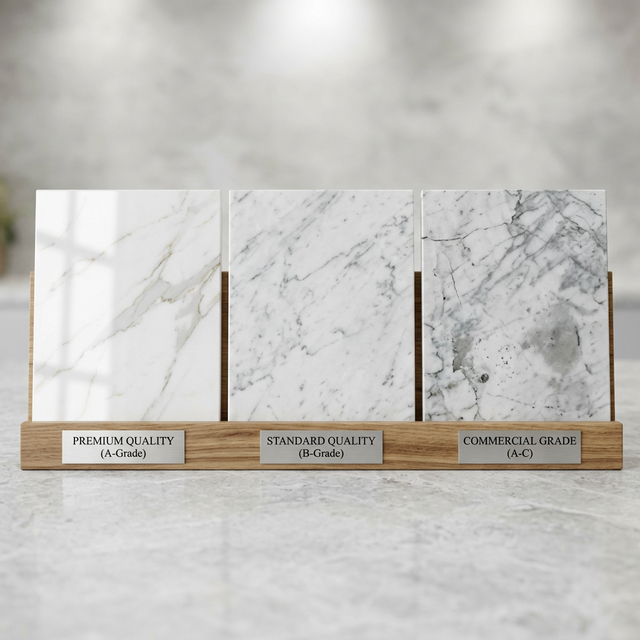
The Three Standard Grades
While terminology varies, the global stone trade commonly uses three tiers. Here's what each grade typically guarantees:
| Criterion | A-Grade (Premium) | B-Grade (Standard) | Commercial Grade |
|---|---|---|---|
| Color Consistency | Minimal variation between slabs (ΔE ≤ 2) | Moderate variation (ΔE 2–4) | Significant variation (ΔE > 4) |
| Veining Quality | Clean, well-defined, aesthetically balanced | Acceptable veining, minor irregularities | Irregular, fragmented, or excessive veining |
| Structural Integrity | No cracks, fissures, or voids | Minor fissures (filled with resin) | Multiple filled fissures, may have visible repairs |
| Surface Defects | Flawless polish, no pitting | Minor pits or surface inclusions | Visible pits, iron spots, or rough patches |
| Slab Size | Full-size slabs (280+ × 160+ cm) | Standard to slightly irregular dimensions | Irregular or smaller-than-standard dimensions |
| Typical Price Premium | Base price × 1.0 | Base price × 0.6–0.8 | Base price × 0.3–0.5 |
| Best Application | Feature walls, kitchen islands, luxury retail | Residential flooring, secondary bathrooms | Cut-to-size tiles, mosaics, outdoor cladding |
What Each Grade Looks Like in Practice
A-Grade: The Investment Piece
A-Grade slabs are the top 15–25% of production from a quarry block. They represent the quarry's signature look — the photos you see in catalogs and showrooms.
Characteristics:
- Veining is clean and flows naturally
- Color is consistent across the slab — both faces and edges
- No structural defects visible to the naked eye
- Full slab dimensions with squared edges
- Can be bookmatched with predictable results
Who Should Buy A-Grade:
- Luxury residential projects — villa feature walls, kitchen islands
- Five-star hotel lobbies and high-end commercial spaces
- Marble furniture — dining tables, coffee tables
- Any application where the stone is the visual hero
B-Grade: The Smart Choice for Many Projects
B-Grade slabs make up 40–50% of quarry production. They're the same stone from the same quarry — just with more natural variation.
Characteristics:
- Veining may be less symmetrical or more concentrated in some areas
- Minor color variation between slabs (may need careful layout planning)
- Small fissures or natural cracks are often filled with color-matched resin (this is standard industry practice and does not compromise structural integrity)
- Some surface inclusions (mineral spots) may be present
Who Should Buy B-Grade:
- Large-area residential flooring where slight variation adds character
- Secondary bathrooms and guest rooms
- Wall tiles where grout lines break up visual continuity
- Commercial projects with budget constraints but quality requirements
- Mosaic tile production — cut-to-size removes most imperfections
Pro Tip: In many cases, skilled fabrication can transform a B-Grade slab into a result that's indistinguishable from A-Grade. The key is working with a factory that understands slab layout and can strategically avoid defect zones during cutting. FutureStone's fabrication team specializes in maximizing slab utilization.
Commercial Grade: Budget-Friendly with Tradeoffs
Commercial Grade represents the remaining 25–35% of quarry output. The stone is genuine natural marble, but it has pronounced defects that limit its applications.
Characteristics:
- Significant color variation — different slabs may look noticeably different
- Multiple filled fissures, sometimes visible to the naked eye
- Irregular dimensions or slabs cut from block edges
- Surface may have pitted areas, iron spots, or uneven polish
- May come from secondary quarry zones or block remainders
Who Should Buy Commercial Grade:
- Outdoor paving and garden paths (imperfections are less visible)
- Large-volume tiling projects where cost/m² is the primary driver
- Cut-to-size tiles where individual tiles are small (30×30 cm or smaller)
- Behind-the-scenes areas (utility rooms, back hallways)
- Samples and prototyping
Grading Varies by Region and Supplier
It's critical to understand that marble grading is not standardized globally. The same grade label can mean different things:
| Region / Context | Grading System Notes |
|---|---|
| Italian quarries | Grade "C1" (premium) to "C3" (commercial). Italy's long tradition means grading tends to be strict. |
| Turkish suppliers | Often use "1st Choice," "2nd Choice," "3rd Choice." Turkish 1st Choice is generally comparable to international A-Grade. |
| Chinese factories | Use A/B/C grading, but standards can vary significantly between factories. Always verify with physical samples. |
| Indian quarries | May use "Premium," "Standard," "Economy." Premium Indian marble can rival European B-Grade in some cases. |
| Brazilian quarries | Often graded by block yield — "Blocco" (best), "Lastra" (standard), "Offcut." Brazilian exotics rarely offer Commercial grade. |
Key takeaway: Never assume that "A-Grade" from Supplier X equals "A-Grade" from Supplier Y. Always request sample slabs and define your quality expectations in writing with objective criteria (ΔE values, acceptable fissure count, surface defect tolerance).
How to Specify Grade in Your Purchase Order
To prevent disputes, include these objective quality criteria in your Proforma Invoice or purchase contract:
Color Consistency
- Specify ΔE tolerance between slabs in the same batch
- Premium projects: ΔE ≤ 2
- Standard projects: ΔE ≤ 3
- Budget projects: ΔE ≤ 5
Structural Standards
- Fissure policy: "No open fissures visible to naked eye at 1 meter distance"
- Resin filling: "Color-matched resin filling acceptable for fissures ≤ 3mm width"
- Iron deposits: "No exposed iron spots that may oxidize and stain"
Surface Quality
- Polish value: ≥ 85 Gloss Units for polished finish (measured with glossmeter)
- Flatness: ≤ 1.5mm deviation per linear meter
- Thickness tolerance: ± 0.5mm for polished slabs, ± 1mm for honed
Physical Properties
Reference ASTM C503 benchmarks:
| Property | Standard | A-Grade Target | B-Grade Acceptable |
|---|---|---|---|
| Water Absorption | ASTM C97 | ≤ 0.15% | ≤ 0.20% |
| Flexural Strength | ASTM C880 | ≥ 10 MPa | ≥ 7 MPa |
| Compressive Strength | ASTM C170 | ≥ 60 MPa | ≥ 52 MPa |
| Abrasion Resistance | ASTM C241 | ≥ 12 (Ha) | ≥ 10 (Ha) |
→ Related reading: How to Choose the Right Marble or Stone Countertop Supplier
Grade vs Price: The Real Economics
Here's a realistic cost comparison using popular white marble as an example:
| Variety | A-Grade (USD/m²) | B-Grade (USD/m²) | Commercial (USD/m²) | Savings (B vs A) |
|---|---|---|---|---|
| Carrara White | $100–140 | $60–90 | $30–50 | 35–40% |
| Elephant White | $70–100 | $45–65 | $25–40 | 35% |
| Black Marquina | $90–130 | $55–80 | $30–45 | 38% |
| Calacatta Viola | $300–500 | $180–280 | Rarely available | 40% |
| Emerald Green | $150–250 | $90–140 | $50–80 | 40% |
Budget Strategy: For a 200 m² villa project, choosing B-Grade Elephant White instead of A-Grade Carrara for floor tiles can save $8,000–15,000 — enough to upgrade the kitchen island to A-Grade Calacatta Viola.
The Role of Resin Treatment
Resin treatment is standard practice in the modern marble industry and is not a sign of inferior quality. Here's what you should know:
| Treatment | Purpose | A-Grade Use | B/C-Grade Use |
|---|---|---|---|
| Surface resin | Enhances polish, fills surface micro-pits | Routine | Routine |
| Structural resin (epoxy net) | Reinforces slabs with natural fissures | Rare | Common |
| Color-enhancing resin | Deepens color and veining contrast | Not acceptable | Sometimes used — verify |
What to request:
- "Surface resin treatment is acceptable"
- "Structural epoxy netting must be invisible under final finish"
- "No color-enhancing resin without buyer pre-approval"
FAQs
Does B-Grade marble mean it's bad quality?
No. B-Grade means more natural variation than A-Grade. It's the same geological material from the same quarry. For many applications — especially large flooring areas and tiled walls — B-Grade is the smart economic choice.
Can I mix A-Grade and B-Grade in the same project?
Absolutely. This is a common professional strategy: A-Grade for focal points (countertops, feature walls) and B-Grade for support areas (floors, staircase treads, secondary bathrooms).
How do I verify grade before shipping?
Insist on pre-shipment inspection — either in person, via video call with the factory, or through a third-party inspection company (SGS, Bureau Veritas, QIMA). Check each slab against your specified criteria.
Does FutureStone offer different grades?
Yes. We maintain A-Grade, B-Grade, and Commercial inventory across our 300+ marble varieties. We'll recommend the right grade for your application and budget. Contact us for a tailored quote →
Part of the Natural Marble Ultimate Guide series. Published by FutureStone Group — direct marble manufacturer and exporter. Request free samples →
Marble grading project buyer guide
A marble grade label is useful only when the supplier explains what it means for the actual slab lot. A-grade, B-grade and commercial grade can describe different combinations of color consistency, vein movement, fissures, resin treatment, thickness tolerance, finish quality and usable yield depending on the quarry, supplier and market. For a real project, the grade should therefore be translated into visible acceptance criteria before the quotation is compared.
This second-stage guide connects marble grading with project procurement. Buyers can use it when selecting slabs for feature walls, floors, kitchen islands, bathroom vanities, staircases, dining tables, coffee tables and hotel or villa stone packages. The existing explanations of A-grade, B-grade and commercial grade remain the foundation; the checks below define what to request before a supplier reserves material or starts fabrication.
marble grade comparison matrix
| Grade label | Typical buyer expectation | Evidence to request | Suitable project use |
|---|---|---|---|
| A-grade | More controlled color and vein appearance with fewer visible defects, subject to the stone type and lot. | Current slab photos, lot reference, fissure and resin disclosure, finish sample and usable yield. | Feature walls, statement islands, premium furniture, lobby surfaces and highly visible villa areas. |
| B-grade | A practical balance of appearance, natural variation and budget, with agreed limits for movement or repaired areas. | Approved variation range, repair map, slab dimensions, thickness tolerance, dry-lay requirement and inspection point. | Residential floors, bathroom vanities, secondary countertops, furniture and projects where natural variation is acceptable. |
| Commercial grade | Budget-oriented material with wider variation or more visible characteristics that must be matched to the application. | Full slab or bundle photos, defect limits, resin treatment, cut-to-size yield, finish consistency and replacement plan. | Large-area floors, selected wall areas, value-engineered developments and applications with a documented acceptance range. |
What a project-grade marble specification should define
- Visual range: define the acceptable base color, vein density, vein direction, open areas, tonal variation and whether a bookmatch or numbered layout is required.
- Current slab evidence: request current slab photos or video with slab IDs, dimensions, thickness, lighting conditions and available quantity instead of relying only on a small sample chip.
- Structural condition: ask the supplier to disclose fissures, filled areas, resin treatment, repairs, warping risk and the usable yield after cutting.
- Finish and fabrication: approve the finish sample, edge profile, thickness tolerance, cut-outs, joints, cut-to-size drawings and dry-lay or mock-up requirement for visible work.
- Application fit: match the grade to traffic, moisture, heat, maintenance, public visibility and replacement requirements rather than choosing the lowest price for every area.
- Quality and delivery: confirm inspection photos, piece labels, crate marks, export packing, packing-list matching and responsibility for damage or replacement before shipment.
marble grading RFQ handoff checklist
A useful marble grading RFQ should include the stone name and origin, intended application, preferred grade, acceptable color and vein range, current slab photos, slab or lot reference, nominal size, thickness, finish, fissure and resin limits, usable yield, cut-to-size drawings, edge details, quantity, inspection point, dry-lay requirement, crate marks, export packing, destination and delivery deadline. For a hotel, villa or commercial package, separate premium visible areas from value-engineered areas so the supplier can quote the right grade for each use instead of applying one label to the whole project.
Before requesting a quotation, compare the marble material range, marble supplier selection guidance, custom stone project applications, stone furniture fabrication and wall and floor tile applications. For export orders, review marble packing methods and send the final grade criteria through FutureStone contact.
FAQ
What should a marble grading RFQ include?
A marble grading RFQ should include the stone name and origin, application, preferred grade, acceptable color and vein range, current slab photos, slab or lot reference, thickness, finish, fissure and resin limits, usable yield, cut-to-size drawings, quantity, inspection point, crate marks, export packing, destination and delivery deadline.
Is A-grade marble always the best choice for every project?
No. A-grade marble may be appropriate for highly visible feature walls, statement islands and premium furniture, while B-grade or commercial grade can be suitable for floors, secondary areas or value-engineered packages when the natural variation and defect limits are approved for the application.
How can buyers verify a marble grade before production?
Buyers should compare the supplier definition with current slab photos, slab IDs, color and vein range, fissure and resin disclosure, thickness and finish samples, usable yield, shop drawings, dry-lay photos and inspection records before approving fabrication.
Need a material or project recommendation?
Share the page, material target or project requirement with our team.