WhatsApp+8613302377586 Phone+8613302377586 E-mailjayden@futurestone.cn
STONE & BUILDING ART
Home > Blog > Industry News >

The Allure of Arabescato White Marble: Bold Veins, Timeless Luxury

The Allure of Arabescato White Marble: Bold Veins, Timeless Luxury

Navigating the Complexities of Arabescato Sourcing requires a shift in mindset for architectural procurement teams — from aesthetics-first to structural-first. While many industry portfolios display Arabescato White Marble (known in Asian markets as 大花白, Dà huā bái) purely as a decorative centrepiece, seasoned specifiers understand the profound complexities behind sourcing this heavily brecciated Carrara-basin stone. The journey from the Apuan Alps to a finalized commercial installation is fraught with variables: managing unpredictable block-to-block colour variation, mitigating the inherent risk of micro-fractures in transit, and maintaining structural integrity through complex fabrication cycles. To successfully execute large-scale, high-end projects featuring authentic natural marble, procurement teams must transition from aesthetic mood boards to rigorous technical oversight. This brief details the critical engineering parameters, defect detection methodologies, manufacturing protocols, and precise payload frameworks required in 2026.

Geological Anatomy and Sub-Quarry Classification

Unlike the sweeping, directional veins of Statuario, genuine Arabescato is characterized by an interconnected, ovoid (egg-shaped) network of grey-to-graphite clasts suspended over an ivory or crisp white matrix — a textbook brecciated limestone recrystallized under intense orogenic pressure within the Apuan Alps. However, treating all Arabescato as a monolithic specification is a costly procurement error. Aesthetic yield, crystalline density, and structural compactness fluctuate significantly based on the specific extraction zone, and failing to isolate the sub-quarry prior to block cutting creates irreversible batch inconsistencies.

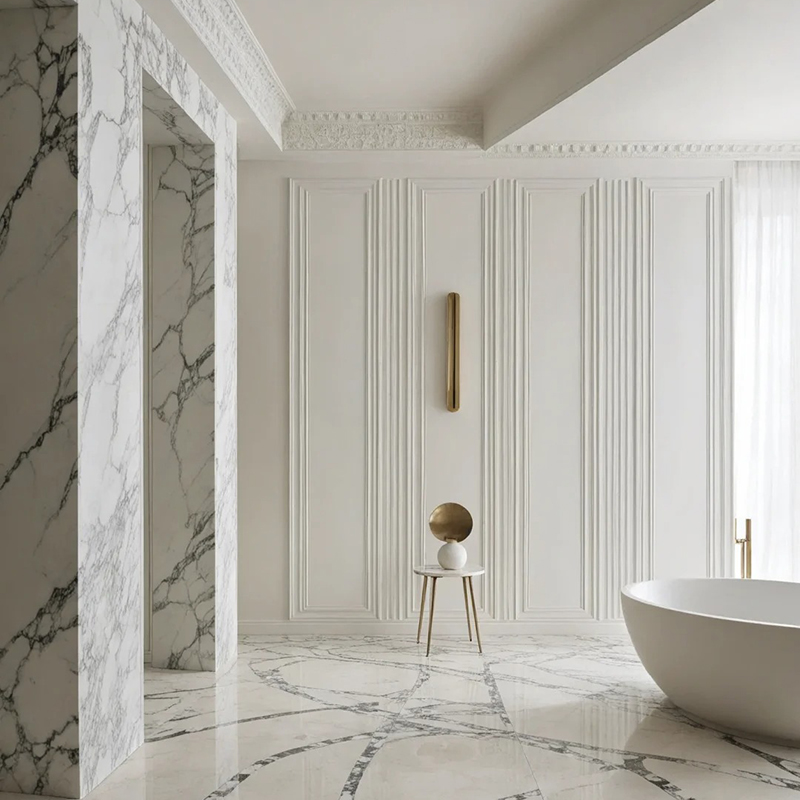
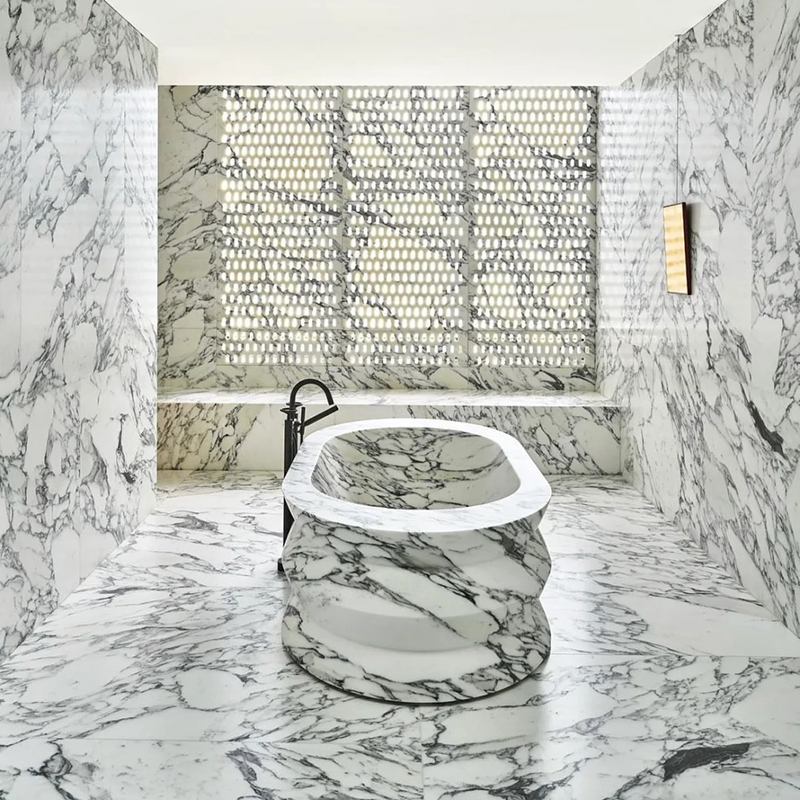
Arabescato White Marble

  • Arabescato Corchia: Extracted from the Corchia quarries in upper Versilia at approximately 1,300 metres above sea level, this variant features intricate, highly dynamic grey-blue vein networks tightly interlocked within a compact crystalline white matrix. Its excellent crystal structure yields superior compressive behavior, making it the preferred sub-quarry specification for load-bearing flooring in high-footfall hospitality environments and expansive lobby flooring.
  • Arabescato Vagli: Originating from the Vagli quarries in the Lucchesia region, this variant offers a sophisticated, softer swirling motion with veins ranging from light grey to greenish gold undertones. Its refined ivory-white background — combined with verified density of 2,715 kg/m³ and compressive strength up to 144 MPa — makes it overwhelmingly favored for seamless, thermally stable transitions in luxury residential surrounds and precision-matched wall cladding.
  • Arabescato Cervaiole (Cervaiola): Quarried from the summit of Mount Altissimo in upper Versilia, Cervaiole is distinguished by its globally renowned purity — a stark, crisp ivory-white base contrasting against a sophisticated light grey egg-shaped vein web. The dramatic visual contrast makes it arguably the most potent choice for bespoke waterjet medallion inlays, feature staircases, and expansive column cladding in ultra-luxury developments.

When sourcing material for large-format wall and floor tile cladding across multi-storey elevations, isolating the specific sub-quarry prior to block cutting is the only reliable methodology to guarantee book-matched batch consistency. Blending extraction zones across a hotel façade or a residential tower lobby is an unrecoverable aesthetic failure at commissioning.

Verified Physical Parameters and Engineering Data

To engineer structural endurance across decades of commercial and residential use, architects and specifiers must rely on verified, industry-standard metrics rather than generalized durability claims. The following technical specifications represent premium-grade Arabescato as independently validated by laboratory standards including EN 1936, EN 13755, EN 12372, and EN 1926.

PropertyStandardVerified Range
Apparent DensityEN 19362,710 – 2,724 kg/m³
Water AbsorptionEN 137550.11% – 0.40% (by volume)
PorosityEN 19360.30 ± 0.03%
Flexural Strength (MOR)EN 1237211.86 – 20.7 MPa
Compressive StrengthEN 1926132.0 – 144.3 MPa
Knoop Microhardness1,393 MPa
Mohs Hardness3
Impact ResistanceEN 1415841 cm
Compressive Strength (Post-Freeze)133 MPa minimum

Engineering Implications for Commercial Specification:

The wide flexural strength range (11.86–20.7 MPa) is not a data anomaly — it reflects the genuine structural variability between sub-quarries and resin treatment quality. Cervaiole-sourced slabs, benefiting from tighter crystalline bonding, consistently test closer to the upper bound. Procurement teams must demand certified laboratory test reports (not manufacturer self-declarations) at the block stage before fabrication commences. The verified Mohs hardness of 3 confirms Arabescato's susceptibility to scratch damage under abrasive foot traffic, which directly dictates finish selection in high-traffic commercial zones.

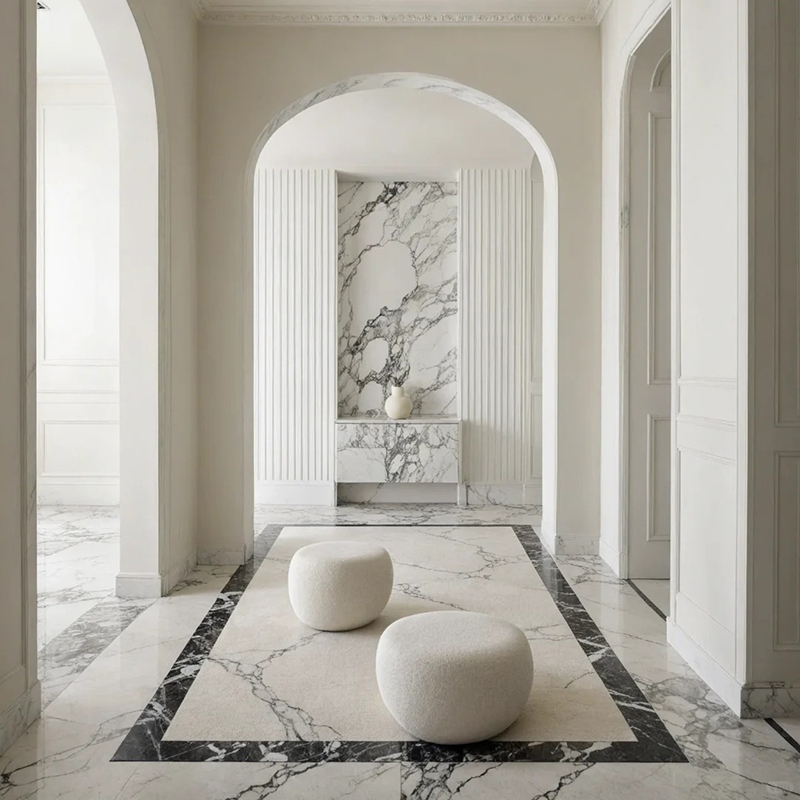
Arabescato White Marble

Regarding water absorption and sealing protocols: the range from 0.11% (tight Corchia cuts under EN 13755) to 0.40% (standard Breccia/Vagli variants) has profound implications for exterior façade engineering and wet-zone installation. Slabs approaching the 0.40% end of the absorption spectrum require double-impregnation sealing cycles using fluoropolymer-based penetrating sealers prior to installation in bathroom surrounds, pool decks, or exterior cladding applications subject to freeze-thaw cycling.

The DCOF (Dynamic Coefficient of Friction) is a critical safety compliance parameter often omitted from stone supplier datasheets. A polished Arabescato slab scores approximately 0.25 wet, which is below the minimum threshold for commercial wet-area applications under ANSI A137.1 (2012) and equivalent standards. Specifying a honed finish raises the wet DCOF to the 0.45–0.55 range, satisfying modern interior safety standards — while simultaneously providing a secondary benefit: honed surfaces elegantly mask the superficial acid-etching that calcium carbonate naturally undergoes from spillage of low-pH liquids over time.

The thermal expansion coefficient of approximately 8.0 × 10⁻⁶ /°C mandates that any exterior cladding application — including curtain wall stone panels and ventilated façade systems — incorporate precisely calculated expansion joints. Under direct solar heat gain in high-insolation markets such as UAE, Saudi Arabia, or Australia, an inadequately jointed 3-metre Arabescato panel will generate sufficient thermal stress to initiate micro-fracturing along its pre-existing brecciated vein lines. For projects in these climates, the standard industry recommendation is to specify expansion joints no wider than 2.5–3.0 metres on both horizontal and vertical axes.

Advanced Manufacturing: Defect Mitigation in Brecciated Stone

The defining aesthetic of Arabescato — its heavy brecciation — is simultaneously its primary structural liability. The deep graphite vein networks are technically mineralogical fault boundaries: zones where the calcium carbonate matrix was disrupted, shattered, and partially recrystallized. Consequently, modern top-tier fabrication for commercial-grade Arabescato relies on a two-stage structural reinforcement protocol: vacuum vibro-compression followed by deep-penetrating epoxy resin infusion at the slab-polishing phase.

During vacuum vibro-compression, the rough-cut slab is placed in a sealed chamber where atmospheric pressure is removed, collapsing microscopic voids within the vein network. Marine-grade epoxy resin is then injected under controlled positive pressure, forcing consolidant deep into fissures that would otherwise remain as invisible structural weakness zones. This process artificially elevates the effective flexural strength of the finished slab and is mandatory for any Arabescato specification destined for stone furniture fabrication, cantilevered countertop overhangs, or large-format exterior cladding panels.

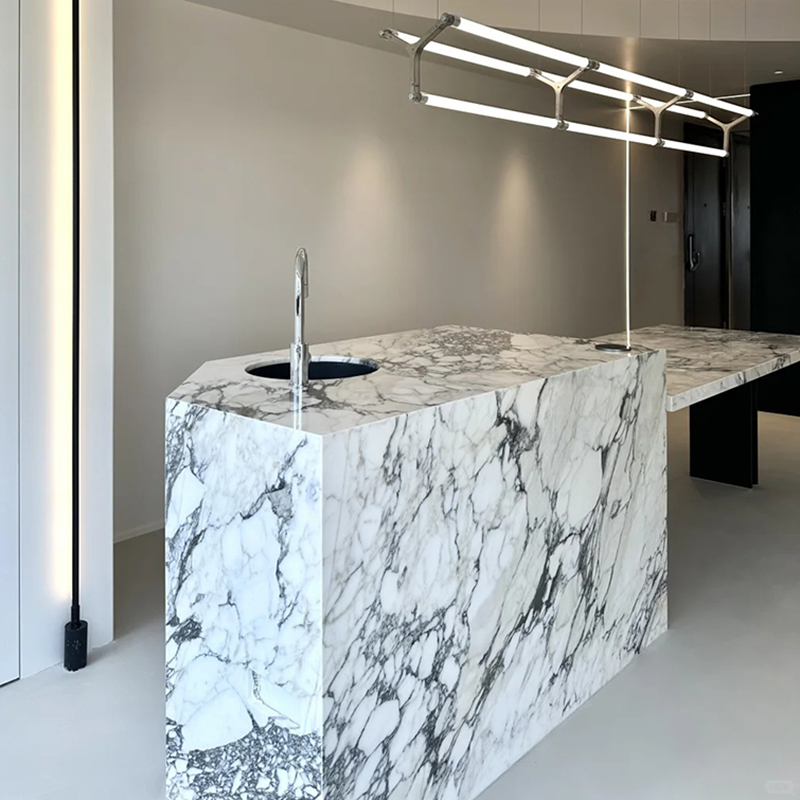
Arabescato White Marble

Resin Pooling Detection — A Mandatory QA Protocol:

Sub-standard fabrication facilities frequently over-apply resin to mask deep structural voids that should disqualify a slab from commercial grading. Under standard visible-light inspection, this over-application is invisible at delivery. Under high-intensity UV inspection (blacklight at 365nm), deep resin pools fluoresce clearly against the stone matrix. More critically, these over-saturated resin zones will yellow noticeably within a 3-to-5-year timeline under UV-A exposure from interior ambient light and solar ingress — catastrophically degrading the monolithic white aesthetic of a hotel lobby or luxury residential interior. For any stone project involving Arabescato, mandating a pre-shipment UV inspection report from the fabrication facility should be a non-negotiable line item in the procurement contract.

CNC Edge Profiling: Feed Rate Parameters for Brecciated Stone:

When fabricating sharp mitered drop-edges for thick-profile stone furniture, monolithic marble coffee tables, or waterfall kitchen countertops, the CNC bridge saw parameters must be dialled down to ultra-low feed rates. The critical failure mode is at the transition point where a dense white calcite clast meets a softer, more porous graphite vein. At standard production feed rates, the cutter head generates sufficient lateral shear force to cause margin blowout — a clean fracture along the vein line that detaches the clast from the edge profile. The result is an irreparable slab loss.

Best-practice CNC parameters for Arabescato edge profiling:

  • Blade Feed Rate: Reduce to 40–60% of standard marble feed rates at vein-transition zones
  • Spindle Speed: Maintain high RPM to reduce per-tooth engagement load on the vein boundary
  • Coolant Flow: Continuous flood coolant to prevent thermal micro-cracking during extended profiling passes
  • Step Depth: Multiple shallow passes (3–4mm depth per pass) rather than single aggressive cuts on mitered edges

These parameters must be specified in the fabrication brief issued to the manufacturing partner — not assumed as defaults.

Finish Selection and Its Structural Consequences

Arabescato is commercially available in four primary surface finishes, each carrying distinct structural, maintenance, and compliance implications far beyond their aesthetic profile.

Polished: The mirror-high gloss finish maximizes the dramatic contrast between the ivory matrix and graphite vein network, but produces the lowest DCOF (~0.25 wet) and the highest susceptibility to visible scratch accumulation given the Mohs 3 hardness rating. Suitable for walls, surrounds, and furniture applications with controlled maintenance protocols.

Honed (Matte): The industry-standard specification for commercial flooring, honed Arabescato achieves wet DCOF in the 0.45–0.55 range while also concealing minor surface etching from daily chemical contact. It subtly softens the vein contrast, lending a more understated luxury register appropriate for residential master suites and hospitality spa environments.

Brushed (Leathered): A mechanical brushing process that opens the surface texture to a subtle topographic relief. This finish significantly increases wet DCOF, provides excellent concealment of fingerprints and minor abrasions, and generates a tactile warmth suited to bespoke waterjet medallion borders and feature accent walls. Note: brushed finishes increase water absorption by partially opening surface pores, demanding more rigorous sealing protocols.

Sandblasted: Used predominantly for exterior anti-slip applications, sandblasted Arabescato achieves the highest DCOF values but sacrifices veining legibility significantly. Its structural roughness creates micro-collection zones for particulate soiling in urban environments, increasing maintenance burden.

Global Logistics and Payload Economics

The realities of international maritime freight directly dictate the final landed cost and structural integrity of any major stone project. At an apparent density of 2,710–2,724 kg/m³, marble containers reach their maximum cargo payload well before they exhaust volumetric capacity — making weight optimization, not volume stacking, the defining constraint in freight planning.

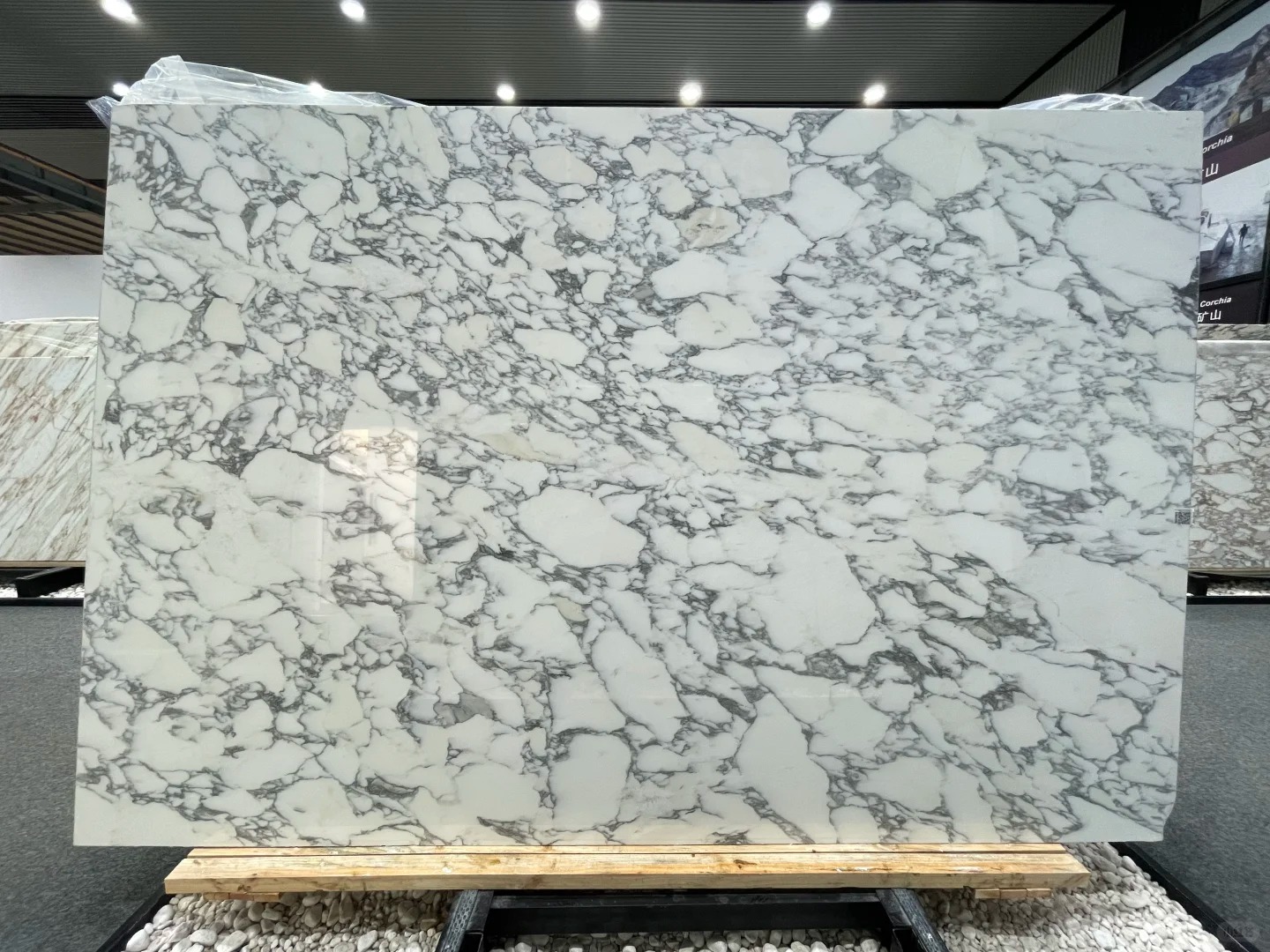
Arabescato White Marble

Standard weight-per-area calculations for load planning:

  • 20mm Arabescato slab: ~54 kg/m²
  • 30mm Arabescato slab: ~81 kg/m²
  • 50mm Arabescato block-cut section: ~136 kg/m²

A standard ISO 20-foot container carries a structural cargo payload ceiling of approximately 21,000–22,000 kg (21–22 metric tonnes), with road delivery restrictions in North America and EU member states typically capping effective payload at 20,000–21,000 kg to comply with axle load regulations. This means a fully optimized 20ft container shipment can safely transport approximately 370–390 m² of 20mm Arabescato slabs before hitting road payload limits, depending on A-frame dead weight and dunnage.

ISPM-15 Compliant Packaging as Structural Engineering:

All wood packaging materials — A-frame bundles, crate sidewalls, floor dunnage, and blocking timber — must be heat-treated or fumigated and stamped with the IPPC mark under the International Standards for Phytosanitary Measures No. 15 protocol. Failure to comply results in detention or destruction of the entire consignment at destination ports, including all Australian, US, Canadian, and EU entry points.

Beyond phytosanitary compliance, the mechanical design of the A-frame bundle is a structural engineering decision. Slabs must be packed vertically in purpose-built A-frames, never horizontal stacked, to distribute compressive load along the slab's strongest axis and prevent flexural overload during trans-oceanic swell. The critical failure mode in inadequately braced shipments is shear fracturing along brecciated vein lines — the same mineralogical fault boundaries that make Arabescato visually distinctive are precisely where propagating fractures will initiate under sustained vibration loads. Best-practice maritime shock-bracing specifications include:

  • Foam interleaving: Minimum 5mm closed-cell polyethylene foam between all slab faces
  • Edge protection: Rigid PVC or rubber corner guards on all four slab edges
  • Cross-brace tensioning: Polypropylene strapping with tensioned ratchet clips, rechecked after container loading
  • Anti-slip dunnage: Non-compressible rubber mats beneath each A-frame base to prevent sliding under dynamic ship motion

HS Code Classification for Customs Compliance:

Arabescato slabs and tiles must be correctly classified under international HS codes to avoid customs delays and duty misapplication. Polished marble slabs and tiles fall under Chapter 68, HS 6802.21 (worked marble, travertine, and alabaster). Raw or rough-cut blocks remain under Chapter 25, HS 2515 (marble and travertite). Misclassification between these codes — a frequent error when procurement teams work through intermediary brokers — generates detention holds, duty re-assessments, and bond requirements that add weeks to project timelines.

Quality Grading and Batch Consistency Protocols

The natural stone industry operates on a tiered grading framework, but "Grade A" designations are self-certified by suppliers unless independently audited — a critical vulnerability in long-range procurement. For Arabescato White Marble in particular, specifiers must impose their own internal grading parameters that go beyond generic "A/B/C" classifications.

Colour and Vein Matching: For any installation exceeding 50 m² where book-matched or vein-matched panels are required, the procurement brief must specify same-block or same-quarry-run batch sourcing. Even within a single sub-quarry, blocks extracted from different bench levels will present measurable variation in background tone (warm ivory vs. cool white) and vein density. The only reliable quality control step is a pre-shipment physical inspection with matched slab layout photographs signed off by the project architect or interior designer before containerization.

Calibration Tolerances for Large-Format Tiles: When specifying large-format wall and floor tiles in sizes exceeding 900mm × 900mm, calibration tolerance must be held to ±0.3mm thickness and ±0.5mm face dimension under EN 14617. Exceeding these tolerances in brecciated marble generates lippage at grout joints that is impossible to correct post-installation without full removal.

Conclusion and Procurement Directive

Securing structurally sound, aesthetically superior Arabescato White Marble extends far beyond creating a compelling render; it is an exercise in rigorous supply chain management, payload economics, deep technical validation, and manufacturing oversight. From mandating sub-quarry isolation and secondary vacuum resin impregnation, to enforcing UV resin pooling detection and exacting ISPM-15 compliant freight payload calculations, leading specifiers cannot afford to treat any step in this chain as a given. The verified physical parameters — compressive strength of 132–144 MPa, flexural strength spanning 11.86–20.7 MPa, and density at 2,710–2,724 kg/m³ — must be backed by independent laboratory certification, not supplier datasheets alone.

To bypass typical supply chain bottlenecks and eliminate procurement guesswork on your next large-scale project, partner with a team possessing the manufacturing transparency, block inventory depth, and end-to-end logistics infrastructure to deliver flawless execution on schedule. For exact payload estimates, CAD structural load analyses, UV resin inspection protocols, sub-quarry block availability, and direct access to premium, fully-inspected Arabescato inventories, contact our engineering and specifier team directly.

Are you looking for a reliable stone and architectural arts contractor?

We can quickly provide customers with market analysis, technical support and customized services.

Get Professional Consultation Solutions

Initiate your project plan, get customized project cost estimates & professional design schemes.

Email

jayden@futurestone.cn

Tel

+8613302377586

Please send your message to us
Our designer partners can discuss your project with specific cases. Let's now improve your home.
Send me information purchases
*Email
Name
Tel
*Title
*Content
Upload
  • Only supports .rar/.zip/.jpg/.png/.gif/.doc/.xls/.pdf, maximum 20MB.
WhatsApp+8613302377586 Phone+8613302377586 E-mailjayden@futurestone.cn
Stone & Building Art
Follow Us
Please send your message
*Email
Name
Tel
*Content